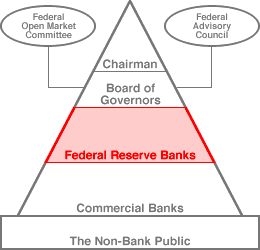
FEDERAL RESERVE DISTRICT BANKS: The 12 government banking institutions that form the core of the U.S. Federal Reserve System and are largely responsible for supervising, regulating, and interacting with commercial banks and carrying out the policies established by the Federal Reserve Board of Governors. Federal Reserve Banks are often termed bankers' banks in that they provide banking services to commercial banks. The 12 District Banks are supported in their activities by 25 Branch Banks.Federal Reserve District Banks are the 12 banking institutions that interact directly with commercial banks and carry out Federal Reserve System policies. More often than not, these 12 Federal Reserve District Banks are commonly termed just Federal Reserve Banks, Reserve Banks, or even Fed Banks. However, the 25 Branch Banks are also Federal Reserve Banks. Federal Reserve Banks play an important role in this U.S. economy and the banking system. These Fed Banks provide banking services to commercial banks, regulate commercial banking activity, process checks and other payments, provide banking services for government agencies, collect and analyze economic data, and undertake a host of other activities.
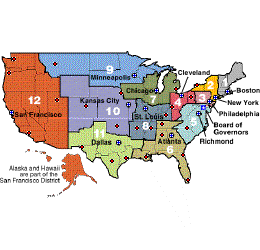
Fed Banks are "technically" owned by member commercial banks. National banks, those chartered by the Comptroller of the Currency, are automatically members of the Federal Reserve System. As part of their startup, national banks purchase shares in their local Reserve Bank. State banks, those chartered by states, are not automatically members of the Fed, but can choose to join by purchasing shares in a Fed Bank. These member shares are reflected in deposits with the Fed Bank (termed Federal Reserve deposits), and while the Fed Banks pay dividends on these ownership shares, like that of private corporations, the shares cannot be traded like corporate stock. Although they are non-profit government entities, Fed Banks are run much like commercial banks. They generate revenue from interest received on a rather extensive holding of U.S. Treasury securities, interest received on discount loans to commercial banks, and fees for services (such as check processing) provided to commercial banks. In addition to typical administrative expenses (salaries, electricity, office supplies), Fed Banks pay dividends to member commercial banks on ownership shares. Any "profit" generated is returned to the U.S. Treasury. Federal Reserve DistrictsWhen the Federal Reserve System was established in 1913, the United States was divided into 12 districts, each headed by a Federal Reserve District Bank. The configuration of the United States into these 12 districts resulted for a couple of reasons:
Districts and BranchesThe 12 Federal Reserve Districts are governed by District Banks. The District Banks are the principal players in the Federal Reserve network of banks. These 12 Fed Banks are where most of the day-to-day Federal Reserve System, central banking action takes place. In addition to the city, each District is also commonly designated by number and/or letter. From 1 to 12, A to L, the 12 banks are 1-A, Boston; 2-B New York; 3-C, Philadelphia; 4-D, Cleveland; 5-E, Richmond; 6-F, Atlanta; 7-G, Chicago; 8-H, St. Louis; 9-I, Minneapolis; 10-J, Kansas City; 11-K, Dallas; 12-L, San Francisco.The 25 Federal Reserve Branch Banks exist to assist their parent District Banks in their assigned duties. Should a commercial bank need Federal Reserve services, it can contact its nearby Branch Bank rather than a more distant District Bank. Branch Banks generally do not provide the entire range of services of District Banks (much like the branch of a commercial bank provides scaled down services) and they are subservient to their District Banks. Ten of the Federal Reserve Districts contain Branch Banks. Only the Boston and Philadelphia districts have no Branch Banks. Branch Banks tend to be more numerous in the less densely populated, larger Federal Reserve Districts in the west and South. Cities containing the 25 Branch Banks, grouped according to their District Bank cities are: Boston (no Branch Banks); New York (Buffalo); Philadelphia (no Branch Banks); Cleveland (Cincinnati, Pittsburgh); Richmond (Baltimore, Charlotte); Atlanta (Birmingham, Jacksonville, Miami, Nashville, New Orleans); Chicago (Detroit); St. Louis (Little Rock, Louisville, Memphis); Minneapolis (Helena); Kansas City (Denver, Oklahoma City, Omaha); Dallas (El Paso, Houston, San Antonio); and San Francisco (Los Angeles, Portland, Salt Lake City). Administrative StructureThe administrative structure of each of the 12 Federal Reserve District Banks is much like that of commercial banks. Each has a board of directors that supervises the overall operation, including the appointment of a president and vice presidents. The board includes 9 members selected to represent commercial banks, business interests, and the general public. The 9 directors are divided into 3 equal classes (A, B, and C).Class A directors are commercial bank presidents. Class B and C directors are drawn from the ranks of the non-bank public and are not eligible to serve on the board if they employees of a commercial bank or bank holding company. Taking this a notch higher, Class C directors are not eligible for the board if they own stock in a commercial bank or bank holding company. Class A directors are elected to the board by commercial banks within the district, specially by commercial banks that are members of the Federal Reserve System (not all commercial banks are members). Class B directors are also elected by member commercial banks. Class C directors are appointed by the Board of Governors of Federal Reserve System in Washington, D.C. The Board of Governors also selects a chairman and deputy chairman from among the Class C directors. Class A and B directors cannot serve as chairman or deputy chairman. The board of directors then appoints the bank president and any vice presidents that undertake the day-to-day administration of the Federal Reserve Bank. One of the most important duties of the Fed Bank president is to serve on the Federal Open Market Committee (FOMC). The FOMC oversees monetary policy and is comprised of the 7 Board of Governors, together with the 12 Federal Reserve District Bank presidents (although only 5 being selected as voting members at any given time). This committee meets every six weeks (give or take), usually on a Tuesday, in Washington, D.C., to discuss the course of monetary policy. Each of the 12 Federal Reserve District Bank presidents is responsible for reporting on economic conditions within their districts at FOMC meetings. These summary analyses and supporting data are released to the public in what is called the Beige Book a couple of weeks before the meetings. FunctionsFederal Reserve Banks provide the operating link between the policies of the Federal Reserve System and commercial banks. Commercial banks have very little contact with the Board of Governors in Washington, D.C., but they are constantly working with their nearby Federal Reserve Bank. While a number of Federal Reserve Bank activities are directed at commercial banks, they also provide services to government agencies and the general public.
Check Out These Related Terms... | monetary economics | monetary policy | central banking | Federal Reserve pyramid | Board of Governors, Federal Reserve System | Chairman of the Board of Governors, Federal Reserve System | Federal Reserve Banks | Federal Reserve Branch Banks | Federal Open Market Committee | Federal Advisory Council | open market operations | discount rate | reserve requirements | Or For A Little Background... | fractional-reserve banking | banks | money | bank reserves | bank panic | business cycles | check clearing | money creation | macroeconomics | traditional banks | And For Further Study... | Federal Deposit Insurance Corporation | Comptroller of the Currency | monetary aggregates | barter | aggregate market | unemployment | inflation | bank balance sheet | gross domestic product | circular flow | goldsmith money creation | Recommended Citation: FEDERAL RESERVE DISTRICT BANKS, AmosWEB Encyclonomic WEB*pedia, http://www.AmosWEB.com, AmosWEB LLC, 2000-2025. [Accessed: December 16, 2025]. |