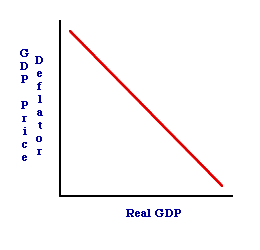
AGGREGATE DEMAND: The total real expenditures on final goods and services produced in the domestic economy that buyers are willing and able to undertake at different price levels, during a given time period (usually a year). Aggregate demand, usually abbreviated AD, is an inverse relation between price level and aggregate expenditures. This is one half of the AS-AD (aggregate market) analysis. The other half is aggregate supply. Aggregate demand consists of four aggregate expenditures--consumption expenditures, investment expenditures, government purchases, and net exports--made by the four macroeconomic sectors--household, business, government, and foreign.Aggregate demand is the total expenditures on gross domestic product. It relates the economy's price level, usually measured by the GDP price deflator, and aggregate expenditures on domestic production, usually measured by real gross domestic product. The aggregate demand relation between aggregate expenditures and price level is inverse--a higher price level is related to a decrease in aggregate expenditures and a lower price level is related to an increase in aggregate expenditures. Aggregate demand plays a similar role in the aggregate market (AS-AD) analysis as that played by market demand in the standard market analysis. Both represent the "buying side" of the market with negatively-sloped curves. Both relate price and quantity. However, differences emerge because aggregate demand is for ALL production in the economy, while market demand is that for a single product. Moreover, the negative slope of the aggregate demand curve is attributable to the interest-rate effect, real-balance effect, and net-export effect, while the slope of the market demand curve is attributable to the income effect and substitution effect. A closer inspection of aggregate demand can be had by examining four specific topics: (1) the role aggregate demand plays in the aggregate market, (2) the aggregate demand curve, (3) the four aggregate expenditures making up aggregate demand, and (4) the price level and the difference between aggregate demand and aggregate expenditures. Aggregate MarketAggregate demand is an integral part of the AS-AD (aggregate market) analysis. The aggregate market is a handy model of the macroeconomy designed to analyze the relationship between total production (real gross domestic product) and the price level (the GDP price deflator). Without the aggregate demand side of the model, very little analyzing can be accomplished. In the same way that the standard market analysis is based on the interaction between market supply and market demand, the aggregate market analysis is based on the interaction between aggregate supply and aggregate demand. There is NO analysis without both.The aggregate market analysis is used to understand assorted macroeconomic events, especially business cycles, inflation, and unemployment. It is also used to analyze the effects of assorted government policies designed to achieve the macroeconomic goals of full employment, stability, and economic growth. The aggregate market is currently THE standard model for macroeconomic analysis. The Aggregate Demand Curve
Aggregate ExpendituresAggregate demand is the relation between aggregate expenditures made on real domestic production and the price level. Aggregate expenditures are the total expenditures on real gross domestic product undertaken in a given time period by the four sectors--household, business, government, and foreign. Expenditures made by each of these sectors are commonly termed consumption expenditures, investment expenditures, government purchases, and net exports.Consumption Expenditures: Consumption expenditures are the expenditures by the household sector on final goods and services undertaken in a given time period. Consumption expenditures are a rather large part of aggregate expenditures, about two-thirds, that are used by households to purchase things like food, clothing, and kitchen appliances. It is often convenient to work with three specific categories of consumption expenditures--nondurable goods, durable goods, and services.
Investment Expenditures: The business sector is responsible for investment expenditures. While investment expenditures are commonly considered expenditures by the business sector on final goods and services undertaken in a given time period, they are not just any business expenditure, but rather expenditures for the purchase of capital goods like factories and equipment. Similar to consumption expenditures, investment expenditures are divided into a three useful categories--structures, equipment, and change in inventories.
Government Purchases: The government sector, like the household and business sectors, buys a portion of the final goods and services produced by the economy. The government's purchase of this production, is conveniently termed government purchases. Consider two points about government purchases.
Net Exports: The foreign sector, which includes everyone who is not a citizen of the domestic economy, also purchases part of domestic production. Net exports is considered the expenditures by the foreign sector on gross domestic product. They are comprised of two parts--exports and imports. Exports are the purchase of domestic production by the foreign sector. Imports are the purchase of foreign production by the three domestic sectors (household, business, and government). Net exports are then exports minus imports. While it might seem as though exports are the correct measure to include as part of aggregate demand, net exports are used for the following reasons.
Price LevelA deeper peek into aggregate demand requires a word or two about the price level. Recall that the basic explanation of aggregate demand includes the phrase, "at different price levels."The price level is essentially the price of the final goods and services produced in the economy, that is, the price of real production. However, because the economy produces thousands of different goods and services, the price level is actually an average of thousands of different prices. The price level is commonly measured using one of two price indexes that average these thousands of prices.
Other DemandsAggregate demand is one of several types of "demand" in the study of economics. When economists speak of "demand" with no modifiers, they are usually referring to "market demand." In addition to market demand and aggregate demand, two other types of demand include factor demand, which is the demand for the services of factors of production, and money demand, which is the demand for money circulating around the economy.Check Out These Related Terms... | aggregate expenditures | aggregate demand curve | aggregate demand and market demand | aggregate demand determinants | aggregate supply | aggregate market analysis | AS-AD model | Or For A Little Background... | macroeconomics | gross domestic product | price level | price index | macroeconomic theories | macroeconomic markets | macroeconomic sectors | demand | Consumer price Index | GDP price deflator | real gross domestic product | National Income and Product Accounts | And For Further Study... | change in aggregate demand | change in aggregate expenditures | aggregate demand shifts | slope, aggregate demand curve | business cycles | circular flow | Keynesian economics | monetary economics | Recommended Citation: AGGREGATE DEMAND, AmosWEB Encyclonomic WEB*pedia, http://www.AmosWEB.com, AmosWEB LLC, 2000-2025. [Accessed: December 15, 2025]. |