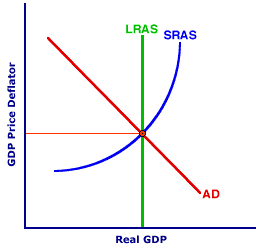
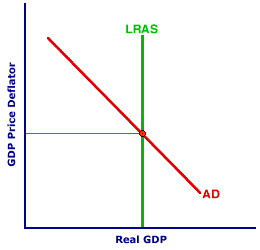
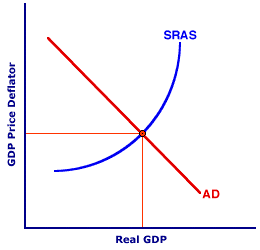
AGGREGATE MARKET: An economic model relating the price level and real production that is used to analyze business cycles, gross production, unemployment, inflation, stabilization policies, and related macroeconomic phenomena. The aggregate market, inspired by the standard market model, but adapted to the macroeconomy, captures the interaction between aggregate demand (the buyers) and short-run and long-run aggregate supply (the sellers). Also known by the names AS-AD model or income-price model, the aggregate market is THE cornerstone model of macroeconomic analysis.The aggregate market model combines the aggregate demand of the four macroeconomic sectors--household, business, government, and foreign--with the aggregate supply of real production (long run and short run). This model emerged onto the theoretical scene in the 1970s, replacing the Keynesian economic model that dominated macroeconomics from the 1940s to the 1970s. In its present form, it provides a general model of the economy that can be used to explain and understand periods of both contractionary unemployment and expansionary inflation. It incorporates the importance of aggregate demand, emphasized by Keynesian economics, as well as aggregate supply, emphasized by classical economics. The extended name for this model is the aggregate product market, to emphasize that it reflects the exchange of gross domestic product in the macroeconomic product markets. However, the two other basic macroeconomic markets--financial markets and resource markets--play key roles behind the scenes and close to the surface of the aggregate market. The Basic Graphical Model
The analytical value of this model results from identifying the equilibrium price level and real production. Then perhaps more informative, the model is used analyze shifts of these three curves and how the shifts affect the equilibrium price level and real production. In so doing implications about unemployment, inflation, income, and other macroeconomic activity can be obtained. Inspired by the MarketLike the standard market model used in microeconomics, the aggregate market captures price and quantity interactions between buyers and sellers. There are, however, two key differences.
Going Long and Short
In particular, an inflationary gap results if short-run equilibrium production exceeds full employment and a recessionary gap occurs if production falls short of full employment. These output gaps not only illustrate the essence of business-cycle instability, but also suggest the role stabilization policies can play in achieving full employment. Three Markets In OneTo be technically precise, the aggregate market is the aggregate "product" market. Including this extra term highlights the fact that the aggregate market is the aggregation of the economy's product markets, markets that exchange final goods and services, or gross domestic product. However, two other aggregated macroeconomic markets, financial and resource, are also working behind the scenes of the aggregate market.
Check Out These Related Terms... | aggregate market analysis | long-run aggregate market | short-run aggregate market | equilibrium, aggregate market | equilibrium, long-run aggregate market | equilibrium, short-run aggregate market | Or For A Little Background... | aggregate demand | aggregate supply | aggregate expenditures | macroeconomic sectors | long-run aggregate supply | short-run aggregate supply | aggregate demand curve | long-run aggregate supply curve | short-run aggregate supply curve | price level | GDP price deflator | real gross domestic product | market | And For Further Study... | disequilibrium, aggregate market | disequilibrium, long-run aggregate market | disequilibrium, short-run aggregate market | output gaps | recessionary gap | inflationary gap | aggregate market shocks | self correction, aggregate market | Keynesian economics | monetary economics | classical economics | Recommended Citation: AGGREGATE MARKET, AmosWEB Encyclonomic WEB*pedia, http://www.AmosWEB.com, AmosWEB LLC, 2000-2025. [Accessed: December 15, 2025]. |