AVERAGE PROPENSITY TO CONSUME: The proportion of household income that is used for consumption expenditures. The average propensity to consume (abbreviated APC) is really nothing more than average consumption. Together with the average propensity to save, it indicates how a given level of income is divided between consumption and saving. A related consumption measure is the marginal propensity to consume.The average propensity to consume (APC) indicates what the household sector does with income. The APC indicates the portion of income that is used for consumption expenditures. If, for example, the APC is 0.9, then 90 percent of income goes for consumption. The standard formula for calculating average propensity to consume (APC) is:
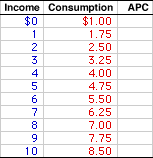
The average propensity to consume is calculated by dividing consumption in the second column by income in the first column. Beginning near the top of the schedule, if household income is $1 trillion, then consumption is $1.75 trillion, giving an average consumption of 1.75. Running the numbers through the APC formula gives: Similar calculations can be performed for each income level. For example, if income from $4, then consumption is also $4 trillion and the APC is equal 1 ($4/$4). If income is $8 trillion, the consumption is $7 trillion and the APC is equal to 0.88 ($7/$8). To display all average propensity to consume values, click the [APC] button. The prime conclusion from a quick look at the numbers is that APC declines as income increases. The APC is 1.75 for $1 trillion of income, then declines to 0.85 for $10 trillion of income. In other words, APC is not constant. The APC declines due to autonomous consumption and induced consumption. Autonomous consumption is the $1 trillion of consumption that takes place if income is zero. Induced consumption is the increase in consumption that occurs due to an increase in income. Because consumption is positive when income is zero, consumption is necessarily greater than income at low income levels, meaning the APC is greater than one. Moreover, while consumption is induced as income increases, the fundamental psychological law means that consumption increases less than income. As such, because the increment in consumption is less than the increment in income, the average declines. This is an application of the average-marginal relation. The average propensity to consume is one of four related measures. The other three are average propensity to save, marginal propensity to consume, and marginal propensity to save.
Check Out These Related Terms... | marginal propensity to consume | marginal propensity to save | average propensity to save | marginal propensity to invest | marginal propensity to import | marginal propensity for government purchases | slope, consumption line | Or For A Little Background... | consumption | consumption expenditures | Keynesian economics | household sector | disposable income | national income | gross domestic product | consumption schedule | consumption line | consumption function | effective demand | psychological law | average-marginal relation | And For Further Study... | autonomous consumption | induced consumption | derivation, consumption line | derivation, saving line | intercept, consumption line | personal consumption expenditures | induced expenditures | autonomous expenditures | aggregate expenditures | aggregate expenditures line | consumption expenditures determinants | Keynesian model | Keynesian equilibrium | injections-leakages model | aggregate demand | paradox of thrift | fiscal policy | multiplier | Recommended Citation: AVERAGE PROPENSITY TO CONSUME, AmosWEB Encyclonomic WEB*pedia, http://www.AmosWEB.com, AmosWEB LLC, 2000-2025. [Accessed: December 15, 2025]. |