DEMAND DECREASE: A decrease in the willingness and ability of buyers to purchase a good at the existing price, illustrated by a leftward shift of the demand curve. A decrease in demand is caused by a change in a demand determinant and results in a decrease in equilibrium quantity and a decrease in equilibrium price. A demand decrease is one of two demand shocks to the market. The other is a demand increase.A demand decrease results from a change in one of the demand determinants. The leftward shift of the demand curve disrupts the market equilibrium and creates a temporary surplus. The surplus is eliminated with a lower price. The comparative static analysis of the demand decrease is that equilibrium quantity decreases and equilibrium price decreases. Demand DeterminantsA decrease in demand can result from a change in any of the five demand determinants.
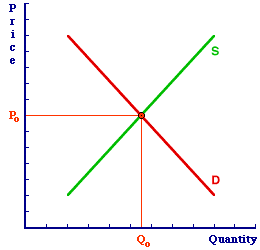
Old to NewFirst, consider the simple comparative static analysis of the demand decrease. The diagram at the right presents the Shady Valley market for Hot Momma Fudge Bananarama Ice Cream Sundaes. The initial equilibrium price is Po and the initial equilibrium quantity is Qo. This market equilibrium, of course, persists until and unless a determinant changes, which is the nature of equilibrium. The particular change under scrutiny is a decrease in demand caused by a change in any of the five demand determinants noted above.
If the price of one substitute-in-consumption (Double-Dot Carmel Fudge Pecan Pie) declines, the quantity demanded (of Double-Dot Carmel Fudge Pecan) increases. But with more Double-Dot Carmel Fudge Pecan satisfying after dinner dessert cravings, there is less demand for Hot Momma Fudge Bananarama Ice Cream Sundaes. As such, the demand for Hot Momma Fudge Bananarama Ice Cream Sundaes decreases. And when demand decreases, the original market equilibrium is disrupted. How is the Hot Momma Fudge Bananarama Ice Cream Sundae market affected? A decrease in the price of a substitute-in-consumption works through the other prices demand determinant to shift the demand curve leftward. Click the [Demand Decrease] button to illustrate the leftward shift of the demand curve. The OLD market equilibrium is no longer equilibrium. A NEW market equilibrium is found at the intersection of the original supply curve and the new demand curve. Click the [New Equilibrium] button to highlight this result. The new equilibrium price is Pe and the new equilibrium quantity is Qe. Note that the price is lower and the quantity exchanged is less. Step by StepNow, consider how this demand shock to the Hot Momma Fudge Bananarama Ice Cream Sundae market can be divided into six steps using the exhibit to the right. While the directions of the changes may differ, these six steps apply to the comparative static analysis of other demand and supply shocks.
One of EightA demand decrease is one of eight market disruptions--four involving a change in either demand or supply and four involving changes in both demand and supply. The other three single shift disruptions are demand increase, supply increase, and supply decrease. The four double shifts are demand and supply increase, demand and supply decrease, demand increase and supply decrease, and demand decrease and supply increase.Check Out These Related Terms... | demand increase | supply increase | supply decrease | demand shock | supply shock | Or For A Little Background... | demand determinants | comparative statics | ceteris paribus | economic analysis | graphical analysis | demand curve | equilibrium | equilibrium price | equilibrium quantity | market equilibrium | change in demand | And For Further Study... | demand and supply increase | demand and supply decrease | demand increase and supply decrease | demand decrease and supply increase | price ceiling | price floor | supply determinants | Recommended Citation: DEMAND DECREASE, AmosWEB Encyclonomic WEB*pedia, http://www.AmosWEB.com, AmosWEB LLC, 2000-2025. [Accessed: December 16, 2025]. |