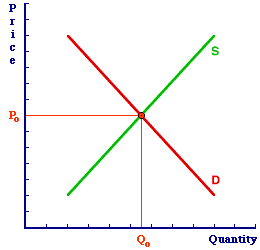
DEMAND DECREASE AND SUPPLY INCREASE: A simultaneous decrease in the willingness and ability of buyers to purchase a good at the existing price, illustrated by a leftward shift of the demand curve, and an increase in the willingness and ability of sellers to sell a good at the existing price, illustrated by a rightward shift of the supply curve. When combined, both shifts result in an indeterminant change in equilibrium quantity and a decrease in equilibrium price.A demand decrease results from a change in any of the five demand determinants. A supply increase results from a change in any of the five supply determinants. By itself, a demand decrease results in a decrease in equilibrium quantity and a decrease in equilibrium price. By itself a supply increase results in An increase in equilibrium quantity and a decrease in equilibrium price. A simultaneous decrease in demand and increase in supply unquestionably generates a decrease in the price. However, the change in the quantity is indeterminant. It might decrease or increase depending on the magnitude of the demand and supply changes. Simultaneous ShocksTo see how a decrease in demand and an increase in supply affects market equilibrium, consider the Shady Valley market for Hot Momma Fudge Bananarama Ice Cream Sundaes.
One Shift at a Time
Both at OnceNow consider simultaneous shifts of Both Curves. Combining both shifts generates an obvious change in price, but a questionable change in quantity. If a decrease in demand decreases equilibrium price and an increase in supply decreases equilibrium price, then both together MUST decrease equilibrium price. The market price of Hot Momma Fudge Bananarama Ice Cream Sundaes in Shady Valley is lower.But what about quantity? The demand shift results in a smaller quantity, and the supply shift leads to a larger quantity. Does quantity end up more or less? Who knows? No one does, not with the available information. The quantity is indeterminant.
Click the [Both Curves] button to see how the market is affected by a decrease in demand and an increase in supply. The demand curve shifts to the left and the supply curve shifts to the right. The resulting equilibrium can be identified by clicking the [New Equilibrium] button. The equilibrium price is now Pe, which as expected is a decrease over the original equilibrium price. Buyers are willing to pay less and sellers charge less. The price decreases. What about quantity? In this little illustration, the new equilibrium quantity happens to be unchanged at Qo, the original equilibrium quantity. Maintaining the same equilibrium quantity, however, is merely coincidence, happenstance, quite literally the luck of the draw. In particular, the new demand and supply curves are drawn in such a way that they shift by the same amount. These two curves could have been drawn such that they shifted by different amounts. And if so, the quantity would have ended up greater or less than the original. Quantity is indeterminant. The reason for the indeterminant quantity is that the relative shift of each curve is unknown. If demand shifts relatively more than supply, then the demand-induced smaller quantity outweighs the supply-induced larger quantity, and the quantity is less. A larger quantity results if the supply shift is relatively more than the demand shift. Because the extent of each shift is not known, quantity is indeterminant. Whenever the demand and supply curves both shift, either quantity or price is indeterminant. One of EightA demand decrease and supply increase is one of eight market disruptions--four involving a change in either demand or supply and four involving changes in both demand and supply. The four single shift disruptions are demand increase, demand decrease, supply increase, and supply decrease. The other three double shifts are demand and supply increase, demand and supply decrease, and demand increase and supply decrease.Check Out These Related Terms... | demand and supply increase | demand and supply decrease | demand increase and supply decrease | demand decrease | supply decrease | demand shock | supply shock | Or For A Little Background... | demand decrease | supply increase | demand determinants | supply determinants | demand curve | supply curve | comparative statics | ceteris paribus | economic analysis | graphical analysis | market equilibrium | change in demand | change in supply | And For Further Study... | price ceiling | price floor | market equilibrium, graphical analysis | aggregate market shocks | Recommended Citation: DEMAND DECREASE AND SUPPLY INCREASE, AmosWEB Encyclonomic WEB*pedia, http://www.AmosWEB.com, AmosWEB LLC, 2000-2025. [Accessed: December 16, 2025]. |