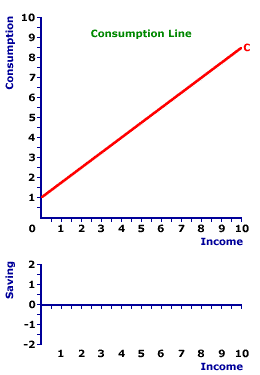
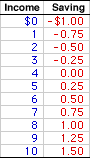
DERIVATION, SAVING LINE: A saving line, a graphical depiction of the relation between household sector saving and income, can be derived from the consumption line. The saving line can also be derived by plotting the saving-income information from a saving schedule or using the slope and intercept values of the saving function. However, derivation from the consumption line emphasis the connection between consumption and income--that the household sector uses a portion of income for consumption and a portion for saving.The saving line can be derived in a variety of ways. The most common method is directly from the consumption line. It can also be derived by plotting the saving-income combinations from a saving schedule. Lastly, the saving line can be derived by plotting the mathematical specification of a saving function using slope and intercept.
The exhibit to the right can be used to derived the saving line from the consumption line. The top panel presents a standard consumption line. This line is a plot of a consumption function specified as: where: C is consumption expenditures and Y is income (national or disposable). The intercept (or autonomous consumption) is $1 trillion and the slope (or induced consumption, which is also the marginal propensity to consume) is 0.75. The key to deriving the saving line is the addition of a 45-degree line. This line indicates every point in the upper panel in which consumption measured on the vertical axis is exactly equal to income measured on the horizontal axis. Such a line has a slope of one and thus exactly bisects the 90-degree angle formed by the vertical and horizontal axes. Click the [45-degree Line] button to make this addition. Because the 45-degree line indicates equality between consumption and income, when compared to the consumption line it can also be used to indicate saving. In particular, the vertical difference between the 45-degree line and the consumption line is saving. If the 45-degree line lies below the consumption line, as is the case for relatively low levels of income, then saving is negative. If the 45-degree line lies above the consumption line, as is the case for relatively high levels of income, then saving is positive. The saving line can be derived by transferring the vertical distance between the 45-degree line and the consumption line from the top panel to the bottom panel of the exhibit. The bottom panel measures saving on the vertical axis and income on the horizontal axis. A click of the [Saving Line] works through the derivation. Note how the vertical distance in the top panel is first identified, then this value is plotted in the bottom panel. Once all points are plotted, the result is the red saving line labeled S. The two features of the saving line are slope and intercept.
Check Out These Related Terms... | saving schedule | saving line | saving function | induced saving | autonomous saving | average propensity to save | marginal propensity to save | consumption line | derivation, consumption line | slope, saving line | intercept, saving line | effective demand | psychological law | Or For A Little Background... | saving | consumption expenditures | Keynesian economics | macroeconomics | household sector | disposable income | national income | And For Further Study... | personal saving expenditures | induced expenditures | autonomous expenditures | aggregate expenditures | derivation, aggregate expenditures line | aggregate expenditures line | saving expenditures determinants | Keynesian model | Keynesian equilibrium | injections-leakages model | aggregate demand | paradox of thrift | fiscal policy | multiplier | Recommended Citation: DERIVATION, SAVING LINE, AmosWEB Encyclonomic WEB*pedia, http://www.AmosWEB.com, AmosWEB LLC, 2000-2025. [Accessed: December 15, 2025]. |