DETERMINANTS: Ceteris paribus factors that are held constant when a curve is constructed. Changes in these factors then cause the curve to shift to a new location. The most common determinants are demand determinants for the demand curve and supply determinants for the supply curve. Other curves used in the analysis of economics also have notable determinants, including the production possibilities curve, the aggregate demand curve, the aggregate supply curve, and the short-run average cost curve.Determinants are ceteris paribus factors that are held constant when a curve depicting the relation between two variables is constructed. Virtually every curve drawn with a two-dimensional graph, especially those used in economic analysis, has one or more ceteris paribus determinants. The reason is that a two-dimensional graph depicts the explicit relation between two variables, even though other relevant variables exist. To isolate the relation between just the two variables, and to construct the corresponding curve depicting this relation, the other factors--the determinants--are held constant.
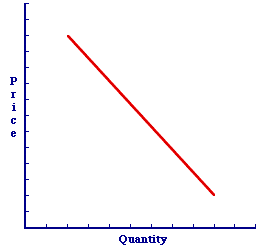
However, other factors, such as the amount of income that buyers have, can also affect demand. The demand curve is constructed assuming that income is constant. If income should change, then so too does demand, resulting in a shifting or repositioning of the demand curve. To illustrate this shift, click the "Determinant Change" button. Other Relevant FactorsWhile economic models typically focus on the relation between the two most important variables in an analysis, this does not mean other variables are irrelevant or unimportant. Quite the contrary. More often than not, the ceteris paribus determinants are held constant as a means of isolating how they affect the basic relation in a systematic, scientific manner. For example, buyers' income is held constant when constructing the demand curve, NOT because it is unimportant to demand, but to see precisely how changes in buyers' income affect demand.Even though the price-quantity relation is the focus of attention in the study of demand, an alternative curve showing the specific relation between buyers' income and quantity, holding price and the four remaining traditional demand determinants constant, can also be constructed. In this analysis, a change in price would then cause a shift of this income-quantity curve. The construction of a three-dimensional graph, such as one relating price, quantity, and buyers' income, is also a possibility. In this case, the ceteris paribus determinants held unchanged can be any remaining traditional demand determinants--such as, buyers' preferences, other prices, buyers' expectations, and number of buyers. A change in any of these four determinants would then cause a shift or repositioning of this three-dimensional surface. A Few Notable DeterminantsThe ceteris paribus determinants for several important economic relations are worth highlighting. These include the determinants for demand, supply, production possibilities, aggregate demand, aggregate supply, and short-run average cost.
Check Out These Related Terms... | demand determinants | supply determinants | change in demand | change in supply | Or For A Little Background... | ceteris paribus | comparative statics | economic analysis | graphical analysis | variables | demand curve | supply curve | production possibilities curve | assumption | cause and effect | economic science | And For Further Study... | market adjustment | demand shock | supply shock | economic growth, production possibilities | buyers' income, demand determinant | elasticity determinants | aggregate demand determinants | aggregate supply determinants | Recommended Citation: DETERMINANTS, AmosWEB Encyclonomic WEB*pedia, http://www.AmosWEB.com, AmosWEB LLC, 2000-2025. [Accessed: December 15, 2025]. |