DIAMOND-WATER PARADOX: The apparently conflicting and perplexing observation that water, which is more useful than diamonds, has a lower price than diamonds. This paradox was proposed by economists in the 1800s as a means understanding the role utility plays in the demand price of a good by differentiating between total utility and marginal utility.The diamond-water paradox poses the perplexing observations: Even though water is obviously important to human activity (life cannot exist without water), the price of water is relatively low. Alternatively, diamonds are clearly much less important to human existence, but the price of diamonds is substantially higher. In other words, the utility obtained from water is obviously very great, while the utility obtained from diamonds is substantially less. The key question that arises is: Why are diamonds so much more expensive than water? Total and MarginalInsight into, and clarification of, the diamond-water paradox results by differentiating between total utility and marginal utility.
In contrast, the total utility generated by diamonds is relatively limited. Diamonds do not provide much overall satisfaction of wants and needs, compared to water. Many humans spend their entire lives without achieving ANY satisfaction from diamonds. Diamonds have very little total utility because they are not nearly as plentiful as water. Most houses do not have hot and cold running diamonds. Most people do not drink eight glasses of diamonds a day, take showers in diamonds, or fill their Olympic-sized swimming pools with hundreds of gallons of diamonds. However, because they are less plentiful, the marginal utility of diamonds is relatively high. An extra ounce of diamonds provides a great deal of extra satisfaction. The Law of Diminishing Marginal UtilityThe key to the marginal utility difference between water and diamonds is the law of diminishing marginal utility. Because water is plentiful, marginal utility is quite low. The law of diminishing marginal utility works its magic on water, driving marginal utility down... to a very low level... to near zero.However, because diamonds are substantially less plentiful, marginal utility is much higher. The law of diminishing marginal utility is not active to the same degree for diamonds. Enter Demand PriceMarginal utility, not total utility, is the critical determinant of price. The price of water is relatively low because the marginal utility is relatively low. The price of diamonds is relatively high because the marginal utility is relatively high.In general, people are willing to pay a relatively higher demand price for a good that generates relatively more satisfaction. However, because goods are sold on an incremental basis--one unit at a time--the additional satisfaction generated by each unit--that is, marginal utility--is the prime determinant of demand price. Going to a Graph
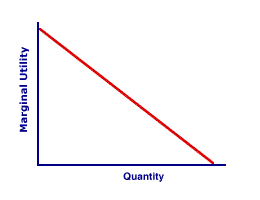
Most importantly, marginal utility determines the demand price that buyers are willing and able to pay for the good. As marginal utility declines, so too does demand price. Consider how the availability of diamonds and water might be reflected with this marginal utility curve.
Paradox SolvedThe apparent contraction between price and utility is cleared up by distinguishing between marginal utility and total utility, and with the understanding that marginal utility, not total utility, is the key to determining price.Moreover, this paradox can be turned on its head by considering what might happen should the relative abundance of water and diamonds change.
Check Out These Related Terms... | consumer surplus | marginal utility and demand | utility measurement | Or For A Little Background... | utility | total utility | marginal utility | marginal utility curve | consumer demand theory | marginal analysis | law of diminishing marginal utility | law of demand | demand | demand price | And For Further Study... | cardinal utility | ordinal utility | util | utilitarianism | marginal utility-price ratio | utility maximization | constrained utility maximization | consumer equilibrium | rule of consumer equilibrium | marginal utility-price ratio | utility analysis | income change, utility analysis | price change, utility analysis | preferences change, utility analysis | Recommended Citation: DIAMOND-WATER PARADOX, AmosWEB Encyclonomic WEB*pedia, http://www.AmosWEB.com, AmosWEB LLC, 2000-2025. [Accessed: December 16, 2025]. |