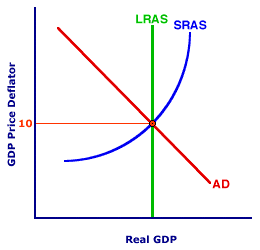
DISEQUILIBRIUM, AGGREGATE MARKET: The state of the aggregate market in which real aggregate expenditures are NOT equal to real production, which results in an imbalance that induces a change in the price level, aggregate expenditures, and/or real production. In other words, the opposing forces of aggregate demand (the buyers) and aggregate supply (the sellers) are out of balance. At the existing price level, either the four macroeconomic sectors (household, business, government, and foreign) are unable to purchase all of the real production that they seek or producers are unable to sell all of the real production that they have.Disequilibrium in the aggregate market, strictly speaking, means that an imbalance exists between demand and supply in the aggregate product markets. It does not necessarily mean that imbalances exist in the other two aggregated markets--financial and resource. In fact, the relative speed of adjustment for the three markets suggests that financial markets are likely to be in equilibrium, while resource markets are not (at least in the short run). Working a Graph
Disequilibrium in the aggregate market results at price levels that do not correspond to intersections of the AD curve and either the LRAS curve or SRAS curve. Consider two alternatives to illustrate:
Short and LongAggregate market disequilibrium can arise in both the long-run aggregate market and the short-run aggregate market. However, disequilibrium in one time frame does not necessarily mean disequilibrium in the other.In particular, disequilibrium in the long-run aggregate market does not necessarily mean disequilibrium in the short-run aggregate market. That is, a given price level might correspond to the intersection of the aggregate demand curve and the short-run aggregate supply curve, but not the intersection of the aggregate demand curve and the long-run aggregate supply curve. This is, in fact, the essence of short-run equilibrium--aggregate expenditures match short-run real production, but NOT long-run, full-employment real production. In contrast, disequilibrium in the short-run aggregate market does necessarily mean disequilibrium in the long-run aggregate market. If aggregate expenditures do not match real production, then they fail to match real production generated in the short-run as well as that generated in the long run at full employment. Adjustment to EquilibriumThe basic adjustment mechanism that restores equilibrium in the aggregate market is essentially the same as that for the standard market model. Imbalances between aggregate demand and aggregate supply induce changes in the price level that ultimately achieve equilibrium.
Check Out These Related Terms... | aggregate market | equilibrium, aggregate market | aggregate market analysis | long-run aggregate market | short-run aggregate market | equilibrium, long-run aggregate market | equilibrium, short-run aggregate market | disequilibrium, long-run aggregate market | disequilibrium, short-run aggregate market | Or For A Little Background... | aggregate demand | aggregate supply | aggregate expenditures | macroeconomic sectors | macroeconomic markets | long-run aggregate supply | short-run aggregate supply | aggregate demand curve | long-run aggregate supply curve | short-run aggregate supply curve | price level | GDP price deflator | real gross domestic product | equilibrium | And For Further Study... | output gaps | recessionary gap | inflationary gap | aggregate market shocks | self correction, aggregate market | Keynesian economics | monetary economics | classical economics | Recommended Citation: DISEQUILIBRIUM, AGGREGATE MARKET, AmosWEB Encyclonomic WEB*pedia, http://www.AmosWEB.com, AmosWEB LLC, 2000-2025. [Accessed: December 16, 2025]. |