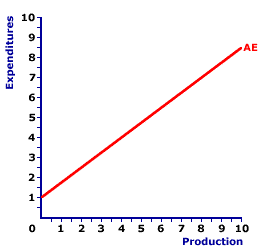
EFFECTIVE DEMAND: A key conceptual notion of Keynesian economics stipulating that the aggregate expenditures on real production is based on existing or actual income rather than the income that would be generated with full employment of resources. Effective demand is embodied in the aggregate expenditures line, which has a positive slope, but a slope of less than one. This concept was proposed by Thomas Robert Malthus in the early 1800s as a counter argument to Say's law found in classical economics and then found new life when John Maynard Keynes developed his theory in the 1930s.Effective demand is a central proposition upon which Keynesian economics is built. This proposition makes the reasonable assertion that aggregate expenditures (especially consumption expenditures) depend on the amount of income that the public actually has available. If the consuming public has more income, then they spend more. If they have less income, then they spend less. Say's Law: Say What?When John Maynard Keynes presented his revolutionary theory of macroeconomics with the publication of The General Theory of Employment, Interest and Money in 1936, he soundly criticized the existing classical economics theory and one of its core principles--Say's law.Say's law, attributed to Jean-Baptiste Say, contends that "supply creates its own demand." In other words, the aggregate production of output generates a sufficient amount of aggregate income to purchase all of the production. According to Say's law, economy-wide downturns (business-cycle contractions) are NOT the result of insufficient demand or the overproduction of output. The effective demand notion was first proposed in the early 1800s by Thomas Robert Malthus, a contemporary of Jean-Baptiste Say, who made the argument that overproduction and the lack of aggregate expenditures and were the source of economic downturns. This notion of effective demand was largely abandoned by classical economists over the ensuing century. John Maynard Keynes gave the concept new life in the 1930s, making it a cornerstone of his theory. Echoing Malthus, Keynes turned Say's law on its head arguing that "demand creates its own supply," at least up to the full employment level of output. Whereas Say's law directed attention to the supply side of the economy, the effective demand principle redirected focus to the demand supply. The history of macroeconomics, dating back to the early 1800s has been characterized by an ongoing debate over the relative importance of the demand side and the supply side. Say's law represents the supply side and effective demand represents the demand side. Aggregate ExpendituresEffective demand is embodied in Keynesian aggregate expenditures. Keynesian aggregate expenditures is composed of expenditures by the four macroeconomic sectors--consumption expenditures by the household sector, investment expenditures by the business sector, government purchases by the government sector, and net exports by the foreign sector.Effective demand is important to aggregate expenditures in two ways.
The red line, labeled AE, is the aggregate expenditures line. It is constructed by adding consumption expenditures, investment expenditures, government purchases, and net exports undertaken by the four macroeconomics sectors at each level of production. The aggregate expenditures line has a positive slope, indicating that greater levels of expenditures result from greater levels of production. However, the slope of the line is numerically less than one. That is, the change in expenditures is less than the change in production. This relation primarily results from the consumption function and the marginal propensity to consume, with minor adjustments from the other three expenditures. The change in aggregate expenditures resulting from a change in aggregate production is termed induced expenditures. This concept can be highlighted in the exhibit with a click of the [Induced] button. The contrasting concept is autonomous expenditures, which are unrelated to changes in production and can be highlighted with a click of the [Autonomous] button. Check Out These Related Terms... | Keynesian economics | classical economics | consumption function | marginal propensity to consume | induced expenditures | autonomous expenditures | aggregate expenditures line | Say's law | psychological law | Or For A Little Background... | aggregate expenditures | aggregate production | consumption expenditures | investment expenditures | changes in private inventories | macroeconomics | gross domestic product | demand | And For Further Study... | assumptions, classical economics | slope, aggregate expenditures line | derivation, aggregate expenditures line | Keynesian model | Keynesian equilibrium | Keynesian aggregate supply curve | multiplier | injections-leakages model | fiscal policy | paradox of thrift | Recommended Citation: EFFECTIVE DEMAND, AmosWEB Encyclonomic WEB*pedia, http://www.AmosWEB.com, AmosWEB LLC, 2000-2025. [Accessed: December 15, 2025]. |