FINANCIAL MARKETS: Markets that exchange financial instruments, or the legal claims to the ownership of physical assets. All four sectors--household, business, government, and foreign operate on both the demand and supply sides of financial markets. The household sector is generally a net buyer of legal claims as it saves a portion of income. The business and government sector tend to be net sellers as they borrow the funds used to pay for expenditures. The study of macroeconomics is concerned with how the flow of income through financial markets affects short-run business-cycle instability and long-run economic growth. The financial markets are one of three primary sets of macroeconomic markets. The other two are product markets and resource markets.Financial markets are important to the macroeconomic analysis of interest rates and their influence on saving and investment. While product markets usually take center stage in macroeconomics, activity in the financial markets are closely connected. In particular, financial markets provide a means of generating the revenue that the business sector uses to pay for investment expenditures. Short-run changes in investment expenditures can cause business-cycle instability. The flow of funds through financial markets also affects the purchase of capital goods, which then affects production capabilities and long-run economic growth. Legal ClaimsFinancial markets exchange legal claims that represent ownership of physical assets. Common examples of legal claims are corporate stocks and bonds, government securities, bank accounts, and money. These legal claims are traded through financial markets such as stock markets, bond markets, commodity exchanges, the open market (which trades government securities), and markets that trade futures and options.The exchange of legal claims also occurs with the lending and borrowing that consumers, business, and banks do through the banking system. Insurance is another legal claim, a claim on an uncertain future, that is also traded through financial markets. Foreign exchange markets trade the currency of different nations, which is essential to foreign trade. Legal claims provide the mechanism for accumulating the funds used for capital investment. In fact, without legal claims and financial markets the economy would find it nearly impossible to invest in large scale capital projects. Buyers and SellersAll four macroeconomic sectors--household, business, government, and foreign--participate on both sides of financial markets. Some members of the household sector buy legal claims as they save a portion of their income and other members sell legal claims as they borrow to pay for purchases. Some businesses buy legal claims when they have extra revenue and others sell legal claims to raise the funds needed to finance investment expenditures.However, the household sector is generally a net buyer of legal claims and thus a net saver, while the business and government sectors are usually net sellers and borrowers. In other words, the household sector diverts a portion of income to the financial markets which is then used by the business and government sectors to finance their spending.
One of ThreeThe financial markets are one of three groups of macroeconomic markets. The other two are product and resource.
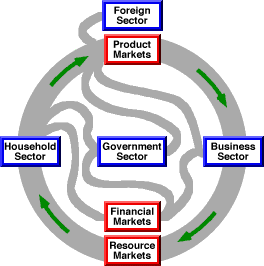
The Circular Flow
The four main components of this simple model are: household sector, business sector, product markets, and resource markets. The household sector contains the consuming population of the economy. The business sector includes all of the producers. The product markets direct production from the business sector to the household sector in exchange for payment flowing in the opposite direction. The resource markets direct factor services from the household sector to the business sector in exchange for payment flowing in the opposite direction. The financial markets enter the circular flow as a means of temporarily diverting household saving away from the product markets. This diverted income is acquired by the business sector to finance investment expenditures and the government sector to finance government purchases. Aggregate EquilibriumIt is often convenient to combine the thousands of individual microeconomic financial markets used to exchange assorted legal claims into an abstract aggregation. Demand in this aggregate financial market reflects the net savings of the household sector as people purchase assorted legal claims through individual markets. And supply in the aggregate financial market reflects the net borrowing by the business and government sectors as they sell legal claims through individual markets.Equilibrium in the aggregate financial market is an essential aspect of macroeconomic analysis. In particular, overall macroeconomic equilibrium, both short-run equilibrium and long-run equilibrium, requires aggregate financial market equilibrium. This exists if the total quantity of legal claims supplied is equal to the total quantity demanded. In other words, saving equals borrowing. However, this does not mean every individual financial market is in equilibrium. One might have a bit of a shortage and another a bit of a surplus. As long as the shortages and surpluses balance out, meaning total quantity demanded is equal to total quantity supplied, then the aggregate financial market is in equilibrium. Check Out These Related Terms... | macroeconomic markets | product markets | resource markets | Or For A Little Background... | macroeconomics | market | demand | supply | factors of production | macroeconomic goals | production | abstraction | microeconomics | equilibrium | ownership and control | And For Further Study... | business cycles | unemployment | inflation | macroeconomic sectors | household sector | business sector | government sector | foreign sector | circular flow | macroeconomic problems | macroeconomic theories | shortage | surplus | money | banking | monetary economics | Recommended Citation: FINANCIAL MARKETS, AmosWEB Encyclonomic WEB*pedia, http://www.AmosWEB.com, AmosWEB LLC, 2000-2025. [Accessed: December 15, 2025]. |