FOREIGN EXCHANGE: A common term for the currency used in "another country" and is in direct contrast to the "domestic currency" used within a given country. More generally, foreign exchange is any financial instrument that gives one country a claim on the currency of another country and which is used to make payments between countries. The most important type of foreign exchange is, of course, the currency of other countries. However foreign exchange also includes financial assents such as bank deposits denominated in another currency. Foreign exchange is appropriately traded through the foreign exchange market and the price of foreign currency is termed the foreign exchange rate.Foreign exchange is the currency and other financial instruments used to conduct transactions and make payments in the foreign sector of a given country. The foreign half of the term infers that the currency is part of a given country's foreign sector, that is, everything beyond the political boundaries of a country. The exchange half of the term infers that these foreign instruments are used to make payments, that is, to facilitate trades, and more to the point that domestic currency is traded for foreign currency to engage international transactions. The domestic currency of one nation, for example dollars used in the United States economy, is the foreign exchange of every other country in the global economy. And the currencies of every other nation (British pounds, Japanese yen, Mexican pesos) are foreign exchange of the given domestic (United States) economy, The exchange of currencies is needed, in part, to facilitate the international trading of goods and services. When nations import and export goods and services they also need to exchange domestic currencies for foreign currencies. The import purchase of a Japanese car by a U.S. consumer requires that U.S. dollars (the currency used by the U.S. consumer for the initial purchase) be exchanged for Japanese yen (the currency used to pay Japanese resources for the production). However, in addition to international trade, foreign exchange is also needed facilitate the flow of capital investment among countries. Should a Japanese investor, for example, seek to purchase or construct capital goods in the United States, then Japanese yen needs to be exchanged for U.S. dollars. Types of Foreign ExchangeWhile the most common type of foreign exchange is currency, other types of financial assets or instruments also qualify. In effect, foreign exchange is any asset denominated in a foreign currency that gives a domestic buyer purchasing power over foreign goods and services. That is, the financial assets in another country comparable to the United States M1 category of money qualify as foreign exchange, including currency (paper bills and metal coins), bank account deposits, and travelers' checks.Who Uses Foreign ExchangeIn general anyone in the domestic economy who purchases foreign goods or services directly from a foreign seller is bound to need foreign exchange, or the currency of the foreign nation. Here are a few of the most notable demanders of foreign exchange.
Foreign Exchange Market(s)Foreign exchange is theoretically traded through what is appropriately termed the foreign exchange market. The foreign exchange market is not in actuality a single market, but is in fact a series of markets for the exchange of each of two currencies. For example, one foreign exchange market exists for trading U.S. dollars and British pounds, and other exists for the trading of U.S. dollars and Japanese yen, and yet another operates to trade British pounds and Japanese yen.If the world consisted of only three countries (United States, Britain, and Japan, as in this example), then there would be only three foreign exchange markets. However, with more countries trading currency, then the number of distinct foreign exchange markets increases exponentially. For example, a world of ten nations would entail 45 foreign exchange markets. Given that the world includes well over 150 countries, there are actually over 10,000 currency-to-currency foreign exchange markets. Much of the trading of foreign exchange physically takes place in the major financial capitals of the world, including New York, London, and Tokyo. However, because most foreign exchange markets are technically considered "over-the-counter," transactions are not necessarily centralized and can take place between a buyer located just about anywhere in the world and a seller located just about anywhere else in the world. The Foreign Exchange Market Model
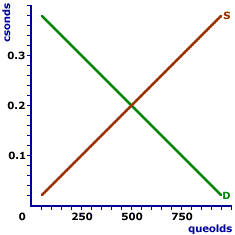
Any international trading, international investing, or other international financial interaction between these two countries requires the exchange of csonds and queolds. The exhibit to the right graphically illustrates the foreign exchange market for csonds and queolds. With this particular representation, the quantity is specified as csonds and the price is specified as queolds per csond. This representation is useful if Northwest Queoldiola seeks to import goods from Csonda, an action that requires the exchange of queolds for csonds. That is, Northwest Queoldiolan importers purchase Csondan currency to enable the subsequent purchase of Csondan goods and services. Make note that the focus of this foreign exchange market can be transposed to Northwest Queoldiolan queolds by measuring queolds as the quantity on the horizontal axis and stating the price as csonds per queolds on the vertical axis. Doing so illustrates that any given foreign exchange market is really two markets in one -- a market for each currency. That is, the foreign exchange market for csonds is the "other side of the coin" for the foreign exchange market for queolds. The demand curve in this exhibit, conveniently labeled D, is the demand for those seeking to purchase queolds. Like other demand curves, this one is negatively sloped. If the price of queolds declines, then buyers are willing to purchase a larger quantity. The supply curve in this exhibit, labeled S, is the supply for those seeking to sell queolds. Like other supply curves, this one is positively sloped. If the price of queolds rises, then sellers are willing to sell a larger quantity. On the surface, equilibrium in this foreign exchange market is much like that in any market. Equilibrium is achieved at the intersection of the demand and supply curves. The equilibrium price is 0.2 csonds per queold and the equilibrium quantity of 500 queolds. Click the [Equilibrium] button to highlight this intersection. The price is termed the currency exchange rate between queolds and csonds. An exchange rate of 0.2 csonds per queold also implies an exchange rate of 5 queolds per csond. Or stated in other terms, the exchange rate between queolds and csonds is at a rate of 5 to 1. Exchange rates, as much as anything, reflect the relative values of each currency, which depend on the productivities of each country and the quantities of currency available. The 5 to 1 exchange rate indicates that five times as many queolds are in circulation and thus each csond can purchase goods that are five times more valuable. The equilibrium quantity of queolds, taken in conjunction with the equilibrium exchange rate, provides a bit of insight into csonds. If 500 queolds are exchanged for csonds at a rate of 5 to 1, then the other side of this exchange involves 100 csonds. In other words, the foreign exchange market for queolds also indicates the equilibrium for the foreign exchange market for csonds. The equilibrium exchange rate in the foreign exchange market for csonds is 5 queolds per csond and the equilibrium quantity of csonds exchanged is 100. Foreign Exchange Rate PoliciesThe foreign exchange rate between currencies is commonly subject to government policy control. Such control can influence international trade, the balance of trade, and the balance of payments. Three particular policy options are used -- flexible exchange rate, fixed exchange rate, and managed flexible exchange rate.
Check Out These Related Terms... | foreign exchange market | exchange rate | exchange rate policies | flexible exchange rate | fixed exchange rate | managed flexible exchange rate | Or For A Little Background... | international finance | international trade | international economics | foreign trade | balance of trade | money | currency | open economy | closed economy | domestic sector | And For Further Study... | balance of payments | current account | capital account | international market | free trade areas | trade barriers | Recommended Citation: FOREIGN EXCHANGE, AmosWEB Encyclonomic WEB*pedia, http://www.AmosWEB.com, AmosWEB LLC, 2000-2025. [Accessed: December 16, 2025]. |