INVESTMENT: The sacrifice of current benefits or rewards to pursue an activity with expectations of greater future benefits or rewards. Investment is the mechanism used to increase the economy's production capabilities and generate economic growth. Investment is typically used to mean the purchase of capital by business in anticipation of profit, which is termed investment expenditures.Investment is the process of foregoing current satisfaction achieved with the consumption of goods and services to pursue activities that are expected to generate greater satisfaction in the future. The most noted activity pursued with investment is the production of capital goods. Other investment activities, such as education, scientific research, and the exploration for natural resources, are also important. Investment, especially that involving capital production, is often financed by selling legal claims through financial markets. This is the primary reason that many people commonly associate the term investment with the purchase of financial assets. Sacrificing Today
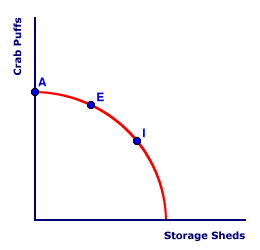
This production possibilities curve illustrates alternative combinations of two goods--crab puffs (a consumption good) and storage sheds (a capital good)--that can be produced by society with existing resources and technology. As a capital good, storage sheds add to the quantity of available resources, which expands the economy's production capabilities in the future. More storage sheds produced today is an investment that means greater production in the future. If the economy selects point A on the production possibilities curve, then there is no investment. The quantity of storage sheds produced is zero and all resources are used to make crab puffs. However, the economy can do a little investment if it selects point E. This production of storage sheds requires a sacrifice in the production of crab puffs, which can be illustrated by clicking the [A to E] button. Further investment in storage sheds, and subsequent sacrifice of crab puffs, occurs if the economy selects point I rather than point E. A click of the [E to I] button will illustrate this alternative. Risk and GrowthThe obvious question that arises with the sacrifice of current satisfaction is: Why? Why would the economy, members of society, give up the production of consumption goods? Why would the people intentional make themselves worse off?The answer is to achieve greater production in the future. The economy sacrifices some today to obtain more tomorrow. In fact, investment is the general process in which society expands, improves, and grows. Without investment, society stagnates and never improves. Without investment, there is no economic growth. A critical dimension of this investment/growth process is risk and uncertainty of what the future might bring. A firm, for example, might invest in the construction of a new factory today anticipating that this will increase profit tomorrow. However, any number of things could go wrong to prevent the realization of the expected profit--government laws, changing market demand, or natural disasters, to name a few. For this reason, investment invariably involves risk. Because no one knows what the future will hold, whenever a certain, known present is foregone for a future outcome, risk and uncertainty are involved. More Than FactoriesThe essence of investment is giving up satisfaction today hoping for more tomorrow. The purchase of capital goods by the business sector is the "poster child" for investment by virtue of its critical role in the economy. But it is by no means the only type of investment.Consider a short list of other, relatively important, examples of investment:
Working the Financial MarketsInvestment in capital goods is intertwined with financial markets. Firms in the business sector sell a wide assortment of legal claims to obtain the funds used to pay for capital goods. For this reason, returns in financial markets, especially interest rates, are closely connected to the expected profitability of capital.Take the case of The Wacky Willy Company, which is considering the construction of a new factory to produce its popular Stuffed Amigos. The factory will entail an investment expense of $10 million. Once operating, it is expected to add $1 million per year to Wacky Willy profits, 10 percent of the initial investment. As such, The Wacky Willy Company is willing to pay an interest of up to 10 percent to borrow the $10 million of funds (by selling legal claims) used for the investment. In competitive financial markets, with other firms also seeking to borrow investment funds, The Wacky Willy Company would be forced to pay this 10 percent interest rate to obtain the funds. The bottom line (literally) is that the interest rates and other returns in financial markets directly reflect the profitability of investment in capital goods by the business sector. Macroeconomic InstabilityBusiness cycles are the recurring ups and downs of macroeconomic activity. The economy generally expands for several years, then it contracts for a year or two. While this macroeconomic instability can be triggered by a number of factors, the most important tends to be investment in capital goods by the business sector.Because capital goods, like factories, buildings, and machinery, tend to take several years to produce and remains productive for several years, the business sector goes through periods where it buys a lot of capital goods, then very few. This results in periods of general economic expansion, then periods of general economic contraction. Of the assorted expenditures on aggregate production by the economy--that by the household, business, government, and foreign sectors--investment expenditures on capital goods by the business sector is the least stable, or most volatile, and tends to be the biggest source of business cycles. Investment Times ThreeThree relatively distinct, but interrelated, notions of investment need to be differentiated.
Check Out These Related Terms... | investment expenditures | investment borrowing | consumption expenditures | consumption | saving | government purchases | net exports | Or For A Little Background... | macroeconomics | business sector | production | financial markets | capital | satisfaction | And For Further Study... | business cycles | macroeconomic problems | circular flow | economic growth | economic goals | macroeconomic sectors | macroeconomic markets | macroeconomic theories | science | investment, production possibilities | economic growth, production possibilities | competitive market | investment business cycles | capital stock, aggregate supply determinant | Recommended Citation: INVESTMENT, AmosWEB Encyclonomic WEB*pedia, http://www.AmosWEB.com, AmosWEB LLC, 2000-2025. [Accessed: December 16, 2025]. |