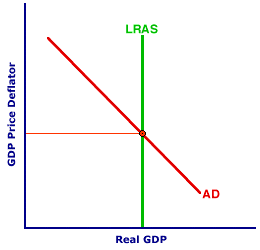
LONG-RUN AGGREGATE MARKET: A macroeconomic model relating the price level and real production under the assumption that ALL prices are flexible. This is one of two aggregate market submodels used to analyze business cycles, gross production, unemployment, inflation, stabilization policies, and related macroeconomic phenomena. The other is the short-run aggregate market. The long-run aggregate market isolates the interaction between aggregate demand and long-run aggregate supply. The key assumption of this model is that ALL prices, especially resource prices, are flexible. The primary result of this model is that the economy achieves long-run equilibrium at full-employment real production.The long-run aggregate market is one of two submodels of aggregate market analysis. It builds on the assumption that all prices are flexible in the long run. This price flexibility ensures that all macroeconomic markets--product, financial, and resource--achieve equilibrium with no surplus or shortage imbalances. The distinguishing feature of the long-run aggregate market is a vertical long-run aggregate supply curve. The long-run aggregate supply curve is vertical at the full-employment level of real production. In other words, the long-run aggregate market can achieve equilibrium at a wide range of alternative price levels, but at only ONE level of real production--full-employment real production. Three Markets in OneTo be technically precise, the long-run aggregate market is the long-run aggregate "product" market. Including this extra term highlights the fact that the long-run aggregate market is the aggregation of the economy's product markets, markets that exchange final goods and services, or gross domestic product. However, two other aggregated macroeconomic markets, financial and resource, are also working behind the scenes of the long-run aggregate market model.
The Graphical Model
Long-run equilibrium occurs at the intersection of the AD and LRAS curves. Price flexibility ensures that all three aggregated macroeconomic markets--financial, product, and resource--are in equilibrium at the intersection of the AD and LRAS curves. Because the LRAS curve is vertical at full-employment real production, long-run equilibrium necessarily occurs at full employment, regardless of shifts in the AD curve or changes in the price level. To demonstrate that long-run equilibrium occurs at the same full-employment level of real production should aggregate demand change, click the [AD Increase] and [AD Decrease] buttons. An increase in aggregate demand leads to a higher price level, but the same level of real production. A decrease in aggregate demand leads to a lower price level, but also the same level of real production. Classical RootsThe roots of the long-run aggregate market can be found in classical economics. Many of the propositions of classical economics, especially flexible prices, are incorporated into the long-run aggregate market. Not surprisingly, the classical economic implication of full employment is also implied by the long-run aggregate market. For this reason, the long-run aggregate supply curve is frequently termed the classical aggregate supply curve.The Short-Run Alternative
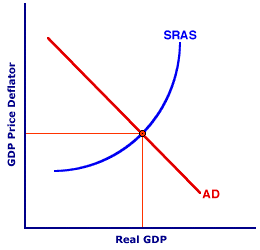
The exhibit to the right presents the standard aggregate demand (AD) and short-run aggregate supply curves (SRAS) that make up the short-run aggregate model. Most notable, the intersection of the AD and SRAS curve indicates equilibrium in the product (and financial) markets, but not necessarily equilibrium in the resource markets. The equilibrium level of real production, as such, could be generating full employment of resources, or it could be less than or greater than full employment. Check Out These Related Terms... | aggregate market | short-run aggregate market | aggregate market analysis | equilibrium, aggregate market | equilibrium, long-run aggregate market | equilibrium, short-run aggregate market | Or For A Little Background... | aggregate demand | aggregate supply | aggregate expenditures | macroeconomic sectors | long-run aggregate supply | short-run aggregate supply | aggregate demand curve | long-run aggregate supply curve | short-run aggregate supply curve | price level | GDP price deflator | real gross domestic product | And For Further Study... | disequilibrium, aggregate market | disequilibrium, long-run aggregate market | disequilibrium, short-run aggregate market | output gaps | recessionary gap | inflationary gap | aggregate market shocks | self correction, aggregate market | Keynesian economics | monetary economics | classical economics | Recommended Citation: LONG-RUN AGGREGATE MARKET, AmosWEB Encyclonomic WEB*pedia, http://www.AmosWEB.com, AmosWEB LLC, 2000-2025. [Accessed: December 16, 2025]. |