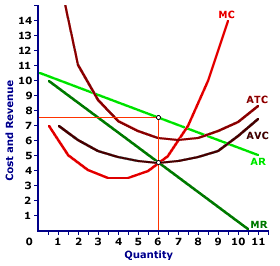
MONOPOLY, LOSS MINIMIZATION: A monopoly is presumed to produce the quantity of output that minimizes economic loss, if price is greater than average variable cost but less than average total cost. This is one of three short-run production alternatives facing a firm. The other two are profit maximization (if price exceeds average total cost) and shutdown (if price is less than average variable cost).A monopoly guided by the pursuit of profit is inclined to produce the quantity of output that equates marginal revenue and marginal cost in the short run, even if it is incurring an economic loss. The key to this loss minimization production decision is a comparison of the loss incurred from producing with the loss incurred from not producing. If price exceeds average variable cost, then the firm incurs a smaller loss by producing than by not producing. One of Three Alternatives
Amblathan-Plus ProductionThe marginal approach to analyzing a monopoly's short-run production decision can be used to identify the economic loss alternative. The exhibit displayed here illustrates the short-run production decision by Feet-First Pharmaceutical, the monopoly producer of Amblathan-Plus, the only cure for the deadly (but hypothetical) foot ailment known as amblathanitis.
For the time being, Feet-First Pharmaceutical maximizes profit by producing 6 ounces of Amblathan-Plus and charges a price of $7.50. This profit-maximizing situation depends on the existing market demand conditions. However, should this demand change, then maximizing a positive profit is not the primary concern of Feet-First Pharmaceutical. Its decision turns to minimizing loss. Click the [Less Demand] button to illustrate the situation facing Feet-First Pharmaceutical with a decrease in demand. As the demand shifts leftward, the marginal revenue curve also shifts leftward. The new profit-maximizing intersection between marginal cost and marginal revenue is at 5 ounces of Amblathan-Plus. The price Feet-First Pharmaceutical charges for this quantity of production is then $6.25. The key is that this new, lower price is between the average total cost curve and the average variable cost curve. This means that Feet-First Pharmaceutical does not generate enough revenue per ounce of Amblathan-Plus sold (average revenue = $6.25) to cover the cost of producing each ounce of Amblathan-Plus (average total cost = $6.60). Feet-First Pharmaceutical clearly incurs an economic loss on each ounce of Amblathan-Plus produced and sold. In fact, if Feet-First Pharmaceutical produces 5 ounces of Amblathan-Plus, then its total cost is $33, but its total revenue is only $31.25. It incurs an economic loss of $1.75, a loss of $0.35 per ounce produced. The Short-Run ChoicePerhaps Feet-First Pharmaceutical should stop producing. Perhaps it would be better off by NOT selling Amblathan-Plus. Unfortunately, Feet-First Pharmaceutical is faced with short-run fixed cost. Feet-First Pharmaceutical incurs a total fixed cost of $10 whether or not it engages in any short-run production. Even if it shuts down production, it still must pay this $10 of fixed cost.As such, Feet-First Pharmaceutical is faced with a comparison between the loss incurred from producing with the loss incurred from not producing. Those are its two short-run choices. If it produces, it incurs a loss of $1.75. If it does not produce, it incurs a loss of $10. The choice seems relatively obvious: Feet-First Pharmaceutical is better off producing 5 ounces of Amblathan-Plus, incurring an economic loss of $1.75, and hoping for an increase in the price. Feet-First Pharmaceutical continues producing in the short run because it generates enough revenue to pay ALL of its variable cost, plus a portion of its fixed cost. By producing 5 ounces of Amblathan-Plus, it generates $31.25 of total revenue. While this revenue falls short of covering the $33 of total cost entirely, it is enough to pay the $23 of total variable cost, with an extra $8.25 left over to pay a portion of the $10 total fixed cost. This is why the economic loss from production is less than total fixed cost. Even though Feet-First Pharmaceutical has complete control of the supply-side of the market, it is still subject to the whims of the demand-side of the market. This $6.25 Amblathan-Plus price generates sufficient total revenue for Feet-First Pharmaceutical to pay ALL variable cost and some fixed cost. However, should this demand drop, then Feet-First Pharmaceutical would have to reevaluate its production decision. If the demand declines enough, Feet-First Pharmaceutical is forced to shut down production in the short run. Check Out These Related Terms... | monopoly, profit maximization | monopoly, shutdown | monopoly, short-run supply curve | short-run production alternatives | breakeven output | Or For A Little Background... | loss minimization rule | shutdown rule | profit maximization | average total cost curve | average revenue curve | profit | economic profit | monopoly | monopoly, characteristics | U-shaped cost curves | profit maximization | And For Further Study... | monopoly, demand | monopoly, short-run production analysis | monopoly, long-run production analysis | monopoly, efficiency | monopoly, total analysis | monopoly, marginal analysis | monopoly, profit analysis | long run industry supply curve | perfect competition, loss minimization | Recommended Citation: MONOPOLY, LOSS MINIMIZATION, AmosWEB Encyclonomic WEB*pedia, http://www.AmosWEB.com, AmosWEB LLC, 2000-2025. [Accessed: December 11, 2025]. | ||||||||||||