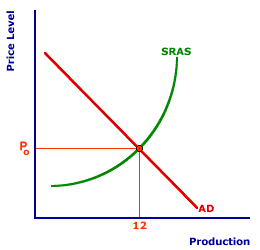
MULTIPLIER, AGGREGATE MARKET: The magnitude of the multiplier impact of an autonomous expenditure change is smaller in the aggregate market analysis, due to a change in the price level, than in the standard Keynesian cross analysis, which assumes a constant price level. The change in the price level triggers an opposite change in aggregate expenditures to that of the initial autonomous expenditure change, thus reducing the magnitude of the multiplier impact.When evaluated using the aggregate market, the standard Keynesian multiplier impact is dampened by price level changes. Changes in the price level trigger the real-balance effect, interest-rate effect, and net-exports effect, which cause a movement along the aggregate demand curve and subsequent changes in aggregate expenditures. These aggregate expenditures change in the opposite direction of the initial change in the autonomous expenditures that set the multiplier process in motion. Standard Keynesian analysis is based on the assumption that the price level is constant or an exogenous variable of the model. Aggregate market analysis, in contrast, includes the price level as an endogenous variable. In Keynesian analysis aggregate production is assumed to rise or fall to match any changes in aggregate expenditures. In aggregate market analysis aggregate production is more realistically subject to constraints which are reflected in a price level changes. The Aggregate Market
Key to this present discussion, any shock to the aggregate market, especially caused by a shift of the aggregate demand curve, results in a change in the price level. Moreover, this price level change will then cause a movement along the aggregate demand curve as equilibrium is restored. With this in mind, suppose that there is an increase in aggregate demand, such as that caused by a $1 trillion increase in investment expenditures. This, of course, causes a rightward shift of the aggregate demand curve and results in a new equilibrium. Click the [AD Increase] button to illustrate this shift. The new equilibrium is achieved at a higher price level, P1, and a larger level of aggregate production, $13 trillion, given by the intersection of the new aggregate demand curve and the original short-run aggregate supply curve. A Keynesian ComparisonHow does this adjustment compare to the standard Keynesian multiplier process? To answer this question, let's dissect this adjustment.
This conclusion can be taken a step farther with the long-run aggregate market. In the long run, aggregate production remains constant at full employment. As such, there is no change in aggregate production, regardless of the change in aggregate expenditures. In this case, the multiplier is zero, there is no multiplier. Period. Check Out These Related Terms... | multiplier | multiplier principle | multiplier, Keynesian cross | multiplier, slope of aggregate expenditures line | multiplier, injections-leakages model | simple expenditures multiplier | simple tax multiplier | expenditures multiplier | tax multiplier | balanced-budget multiplier | Or For A Little Background... | Keynesian cross | Keynesian economics | aggregate market | short-run aggregate market | price level | aggregate demand curve | real-balance effect | interest-rate effect | net-export effect | slope, aggregate demand curve | aggregate expenditures | And For Further Study... | paradox of thrift | money multiplier | fiscal policy | aggregate market analysis | aggregate market shocks | aggregate demand increase, short-run aggregate market | aggregate demand increase, long-run aggregate market | Recommended Citation: MULTIPLIER, AGGREGATE MARKET, AmosWEB Encyclonomic WEB*pedia, http://www.AmosWEB.com, AmosWEB LLC, 2000-2025. [Accessed: December 15, 2025]. |