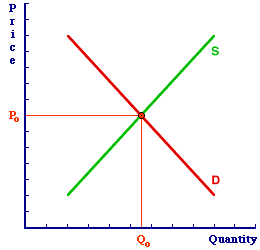
PRICE: An asset or item voluntarily exchanged in a market transaction for another asset or item. This item or asset is usually, but not necessarily, money. A barter transaction occurs if money is NOT one of the assets or items exchanged. In a standard market diagram, price is displayed on the vertical axis.Price plays a central role in economics, especially microeconomics and the study of markets. A great deal of economic analysis focuses on explaining prices--why they rise, why they fall, why they achieve the levels they do. In fact, decades ago, microeconomics was commonly termed price theory.
Two Prices In OnePrice is commonly viewed as either the cost of purchasing a product or alternatively as the revenue received from selling a product. Both are essentially correct. The price of a product is something of value that is given up by buyers and received by sellers in exchange for the product. This two-sided exchange results in two key notions of price.
One Equilibrium PriceEquilibrium price results when the demand price and supply price are equal. This equality means that the quantity demanded and the quantity supplied are also equal and that the market has achieved equilibrium. This is commonly termed the market-clearing price because it "clears" the market by eliminating shortages or surpluses.It is often useful to distinguish between the equilibrium price, which is the price needed to clear the market and achieve equilibrium, and the actual price or the existing price, which is the price that "actually exists" in the market. If the actual price is not equal to the market-clearing equilibrium price, then the market has either a shortage or a surplus. The Market BalancerPrice plays THE key role in balancing the market forces of demand and supply. If a market is faced with a surplus or a shortage, then the price adjusts to achieve equilibrium.
The Great AllocatorOne reason for the economic focus is that prices are essential to the allocation of resources in a market-oriented economy. Like traffic lights, prices direct the movement of resources between consumption and production activities and provide important signals to buyers and sellers.
Check Out These Related Terms... | exchange | voluntary exchange | quantity | market demand | market supply | Marshallian cross | Or For A Little Background... | market | competitive market | allocation | economic thinking | scarcity | opportunity cost | satisfaction | value | And For Further Study... | second rule of subjectivity | fourth rule of competition | seven economic rules | incentive | invisible hand | three questions of allocation | market-clearing price | equilibrium price | price level | price floor | price ceiling | elasticity | Recommended Citation: PRICE, AmosWEB Encyclonomic WEB*pedia, http://www.AmosWEB.com, AmosWEB LLC, 2000-2025. [Accessed: December 16, 2025]. |