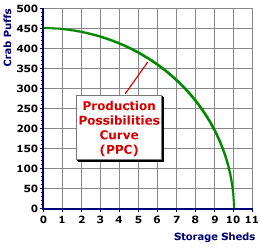
PRODUCTION POSSIBILITIES CURVE: A curve that illustrates the production possibilities of an economy--the alternative combinations of two goods that an economy can produce with given resources and technology. A production possibilities curve (PPC) represents the boundary or frontier of the economy's production capabilities, hence it is also frequently termed a production possibilities frontier (PPF). As a frontier, it is the maximum production possible given existing (fixed) resources and technology. Producing on the curve means resources are fully employed, while producing inside the curve means resources are unemployed. The law of increasing opportunity cost is what gives the curve its distinctive convex shape.
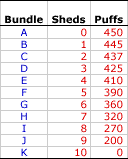
A standard production possibilities curve for a hypothetical economy is presented here. This particular production possibilities curve illustrates the alternative combinations of two goods--crab puffs and storage sheds--that can be produced by the economy. The Set UpAccording to the assumptions of production possibilities analysis, the economy is using all resources with given technology to efficiently produce two goods--crab puffs and storage sheds. Crab puffs are delicious cocktail appetizers which have the obvious use of being eaten by hungry people, usually at parties. Storage sheds are small buildings used to store garden implements, lawn mowers, and bicycles.This curve presents the alternative combinations of crab puffs and storage sheds that the economy can produce. Production is technically efficient, using all existing resources, given existing technology. The vertical axis measures the production of crab puffs and the horizontal axis measures the production of storage sheds.
Key Economic ConceptsAs a introductory model of the economy, the production possibilities curve is commonly used to illustrate basic economic concepts, including full employment, unemployment, opportunity cost, economic growth, and investment.
Slope
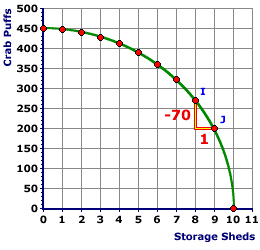
For the production possibilities curve to the right, this is the change in the quantity of crab puffs (rise) divided by the change in the quantity of storage sheds (run). Here is a handy formula for calculating the slope of the production possibilities curve.
For example, the slope of the production possibilities curve between points I (8 sheds and 270 dozen crab puffs) and J (9 sheds and 200 dozen crab puffs) is -70. The rise is a decrease of 70 and the run is an increase of 1.
Check Out These Related Terms... | production possibilities | production possibilities schedule | opportunity cost, production possibilities | full employment, production possibilities | unemployment, production possibilities | investment, production possibilities | derivation, production possibilities curve | law of increasing opportunity cost | Or For A Little Background... | three questions of allocation | graphical analysis | assumptions, production possibilities | technical efficiency | economic efficiency | opportunity cost | unemployment | full employment | technology | efficiency | And For Further Study... | economic goals | economic analysis | seven economic rules | distribution standards | scarcity | factors of production | scientific method | economic thinking | fallacies | production cost | short-run production analysis | Recommended Citation: PRODUCTION POSSIBILITIES CURVE, AmosWEB Encyclonomic WEB*pedia, http://www.AmosWEB.com, AmosWEB LLC, 2000-2025. [Accessed: December 16, 2025]. |