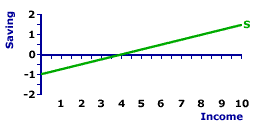
SLOPE, SAVING LINE: The positive slope of the saving line is also termed the marginal propensity to save (MPS). This slope is greater than zero but less than one, reflecting induced saving and the Keynesian psychological law of consumer behavior that saving increases by less than the increase in income. The slope of the saving line provides the foundation for the slope of the leakages line used in the injections-leakages model. It thus also affects the magnitude of the multiplier process.
A representative saving line is presented in the exhibit to the right. This green line, labeled S in the exhibit, is positively sloped, indicating that greater levels of income generate greater saving by the household sector. This positive relation corresponds to the fundamental psychological law of Keynesian economics. The saving line graphically illustrates the saving-income relation for the household sector, which is the foundation of the leakages line used in Keynesian economics to identify equilibrium income and production. The slope of the saving line presented here is positive, but less than one. In fact, the slope of the saving line is numerically equal to the marginal propensity to save. In this case the slope is equal to 0.25. The positive slope reflects induced saving--more income means more saving. It also reflects the basic Keynesian psychological law. Click the [Slope] button to illustrate. To illustrate the equality between slope and the marginal propensity to save, consider the equations for each. The slope of the saving line is specified as the "rise" over the "run." The rise is the change in saving measured on the vertical axis and the run is the change in income measured on the horizontal axis. The marginal propensity to save (MPS) is the incremental change in saving resulting from an incremental change in income. The slope of the saving line is the marginal propensity to save, they are one and the same. The positive slope of the saving line reflects induced saving, which is saving that depends on the level of household sector income. If the household sector receives more income, then it is induced to undertake additional saving. Of course, a drop in income induces the household sector to reduce saving. Check Out These Related Terms... | saving line | intercept, saving line | saving line | slope, saving line | intercept, saving line | saving schedule | saving function | induced saving | autonomous saving | average propensity to save | marginal propensity to save | derivation, saving line | effective demand | psychological law | Or For A Little Background... | saving | consumption | consumption expenditures | Keynesian economics | macroeconomics | household sector | disposable income | national income | gross domestic product | And For Further Study... | injections | injections-leakages model | personal consumption expenditures | induced expenditures | autonomous expenditures | aggregate expenditures | aggregate expenditures line | derivation, consumption line | consumption expenditures determinants | Keynesian model | Keynesian equilibrium | aggregate demand | paradox of thrift | fiscal policy | multiplier | Recommended Citation: SLOPE, SAVING LINE, AmosWEB Encyclonomic WEB*pedia, http://www.AmosWEB.com, AmosWEB LLC, 2000-2025. [Accessed: December 15, 2025]. |