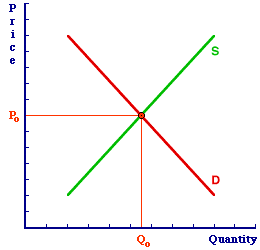
SUPPLY SHOCK: A disruption of market equilibrium caused by a change in a supply determinant and a shift of the supply curve. A supply shock can take one of two forms--a supply increase or a supply decrease. This is one of two disruptions of the market. The other is a demand shock.A supply shock to the market results when the supply curve is shifted due to a change in one of the five supply determinants--resource prices, production technology, other prices, sellers' expectations, and number of sellers. The supply shock comes in two varieties.
Supply IncreaseAn increase in supply can result from a change in any of the five supply determinants.
The surplus then induces a decrease in the price (click the [Price Decrease] button). The price decrease causes an increase in quantity demanded and a decrease in quantity supplied. The result of these quantity changes is a new equilibrium at a lower price and a larger quantity. Click the [New Equilibrium] button to display this outcome. The comparative static analysis reveals a decrease in the equilibrium price and an increase in the equilibrium quantity. An increase in supply results in an increase in the equilibrium quantity. The supply shift means that sellers want to sell more. Buyers are willing to accommodate sellers. However, to appease their increased supply, buyers must pay a lower price in accordance with the law of demand. Supply DecreaseA decrease in supply can result from a change in any of the five supply determinants.
The shortage then induces an increase in the price (click the [Price Increase] button). The price increase causes a decrease in quantity demanded and an increase in quantity supplied. The result of these quantity changes is a new equilibrium at a higher price and a smaller quantity. Click the [New Equilibrium] button to display this outcome. The comparative static analysis reveals an increase in the equilibrium price and a decrease in the equilibrium quantity. A decrease in supply results in a decrease in the equilibrium quantity. The supply shift means that sellers want to sell less. Buyers are willing to accommodate sellers. However, to appease their decreased supply, buyers are willing to pay a higher price in accordance with the law of demand. Summarizing the Changes
However, because the demand curve does NOT shift, the market is constrained to move ALONG the demand curve and follow the law of demand. If the quantity increases, then the price decreases. If the quantity decreases, then the price increases. Check Out These Related Terms... | supply increase | supply decrease | demand shock | demand increase | demand decrease | Or For A Little Background... | supply determinants | comparative statics | ceteris paribus | economic analysis | graphical analysis | supply curve | equilibrium | equilibrium price | equilibrium quantity | market equilibrium | change in supply | change in demand | And For Further Study... | demand and supply increase | demand and supply decrease | demand increase and supply decrease | demand decrease and supply increase | price ceiling | price floor | demand determinants | Recommended Citation: SUPPLY SHOCK, AmosWEB Encyclonomic WEB*pedia, http://www.AmosWEB.com, AmosWEB LLC, 2000-2025. [Accessed: December 16, 2025]. |