THREE-SECTOR INJECTIONS-LEAKAGES MODEL: A variation of the Keynesian injections-leakages model that includes the three domestic sectors--the household sector, the business sector, and the government sector. This model provides an alternative to the three-sector aggregate expenditures (Keynesian cross) analysis of government stabilization policies, especially how fiscal policy changes in government purchases and taxes can be used to close recessionary gaps and inflationary gaps. Equilibrium is identified as the intersection between the S + T line and the I + G line. Two related variations are the two-sector injections-leakages model and the four-sector injections-leakages model.The three-sector injections-leakages model provides an alternative to the more common three-sector Keynesian model; the Keynesian cross, aggregate expenditures-aggregate production model of the macroeconomy. Both models provide essentially the same analysis and are essentially "two sides of the same coin." The key difference between the two models is that consumption is explicitly eliminated from the injections-leakages variation. Whereas the Keynesian cross builds on the consumption function, the injections-leakages model builds on the saving function. Three SectorsThe three sectors included in this three-sector injections-leakages model are the household sector, the business sector, and the government sector.
Injections and LeakagesOne half of the injections-leakages model is injections, which are non-consumption expenditures on aggregate production. The three injections are investment expenditures, government purchases, and exports. These are termed injections because they are "injected" into the core circular flow of consumption, production, and income. In the three-sector injections-leakages model, investment expenditures and government purchases are the two injections included.The other half of the injections-leakages model is leakages, which are non-consumption uses of the income generated from production. The three leakages are saving, taxes, and imports. These are termed leakages because they are "leaked" out of the core circular flow of consumption, production, and income. In the three-sector injections-leakages model, saving and taxes are the two leakages included. Equilibrium in the injections-leakages model relies on a balance between the injections into the core circular flow and leakages out of the flow. If leakages match injections, then the volume of the core circular flow does not change. This is the same as achieving a balance between the water flowing from a faucet into a sink and that flowing out through the drain. When these two flows are equal, then the total amount of water IN the sink does not change. Equilibrium! In the three-sector injections-leakages model, equilibrium is identified as a balance or equality between the sum of saving and taxes and the sum of investment expenditures and government purchases. The Injections-Leakages BalanceA balance between injections and leakages generates the same equilibrium as a balance between aggregate expenditures and aggregate production. A little manipulation of the Y = AE equilibrium condition illustrates why.
This results indicates why the key classical assumption that saving is equal to investment does not necessarily hold. Saving need not equal investment (if taxes do not equal government purchases) when the macroeconomy is equilibrium. The Graphical Model
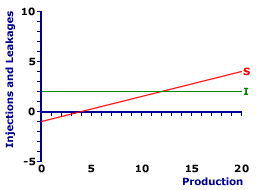
We now need to add the government sector's injection and leakage, starting with government purchases. Like we did with investment, let's assume that government purchases are autonomous. Using induced government purchases won't really change the conclusions. Click the [Government Purchases] button to add this injection. The result of this button-clicking is the addition of a second horizontal line, labeled I + G. This line is the sum of autonomous investment and autonomous government purchases. It is derived by adding autonomous government purchases, G, to the investment line, I. The next addition is taxes, the government sector's leakage. For simplicity, let's also presume that taxes are autonomous. Click the [Taxes] button to add this leakage. You should see a new line appear in this diagram, labeled S + T. This line is the sum of saving and taxes and is derived by adding autonomous taxes, T, to the saving line, S. The slope of the S + T line is parallel to the saving line, S, and is equal to the marginal propensity to save. The inclusion of government purchases and taxes gives us the three-sector injections-leakages model. Equilibrium in this model is found in much the same way as the two-sector model, by equating injections and leakages. The only difference is the number of injections and leakages included. More specifically, equilibrium is the level of aggregate production corresponding with the intersection of the I + G line and the S + T line. Click the [Equilibrium] button to highlight this level. What special insight can be derived from this equilibrium?
Two Other VariationsThe three-sector injections-leakages model is one of three variations, each based on a different combination of the four macroeconomic sectors, and thus a different number of injections and leakages.
Check Out These Related Terms... | two-sector injections-leakages model | four-sector injections-leakages model | injections-leakages model | injections | leakages | injections line | leakages line | saving-investment model | Keynesian model | Or For A Little Background... | Keynesian economics | Keynesian cross | aggregate expenditures | saving line | investment line | effective demand | induced expenditures | autonomous expenditures | macroeconomics | macroeconomic sectors | saving | investment expenditures | government purchases | taxes | imports | exports | And For Further Study... | two-sector Keynesian model | three-sector Keynesian model | four-sector Keynesian model | expansionary fiscal policy | contractionary fiscal policy | automatic stabilizers | Keynesian cross and aggregate market | expenditures multiplier | accelerator principle | paradox of thrift | aggregate market analysis | business cycles | Recommended Citation: THREE-SECTOR INJECTIONS-LEAKAGES MODEL, AmosWEB Encyclonomic WEB*pedia, http://www.AmosWEB.com, AmosWEB LLC, 2000-2025. [Accessed: December 15, 2025]. |