TWO-SECTOR KEYNESIAN MODEL: A Keynesian model of the macroeconomy that includes the two private sectors, the household sector and the business sector. This Keynesian model variation, often termed the basic Keynesian model or the private sector Keynesian model, captures the interaction between induced consumption expenditures and autonomous investment expenditures. This model is commonly used to illustrate the basic workings of Keynesian economics, including equilibrium, disequilibrium, and the multiplier. Equilibrium is identified as the intersection between the C + I line and the 45-degree line. Two related variations are the three-sector Keynesian model and the four-sector Keynesian model.The two-sector Keynesian model is the simplest representation of the key principles of Keynesian economics. It is commonly termed the basic or private sector Keynesian model because it (1) captures the basic essence of Keynesian economics and (2) includes only the two private sectors--household and business. This variation is typically used in introductory economics courses to introduce Keynesian economic theory. The Private SectorTo get the ball rolling consider the private sector, which is the combination of the household sector and the business sector, the two domestic sectors that engage in voluntary market exchanges and allocate resources through individual decisions.The private sector should be contrasted with the public sector, or government sector, which is the sector that forces involuntary resource allocation decisions on the rest of the economy through laws, rules, and regulations. The distinction between the private and public sectors is critical in Keynesian economics. This is largely due to the Keynesian view that the private sector (especially the business sector) is the source of business-cycle instability, and that stabilization policies by the public sector are the recommended way of stabilizing the economy. The private sector, as noted above, contains the household and business sectors.
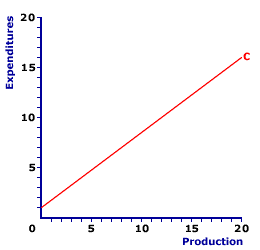
Autonomous and InducedThe inclusion of the household and business sectors highlights a critical distinction between two types of expenditures--autonomous and induced.
This simplification makes it possible to identify two key aspects of Keynesian equilibrium.
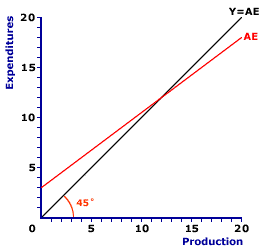
Aggregate Expenditures: The C + I Line
The exhibit to the right can be used to illustrated the two-sector (C + I) aggregate expenditures line.
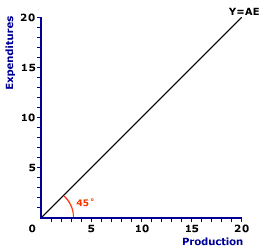
An Equilibrium Guide: The 45-Degree Line
The equilibrium guide line is a 45-degree line that bisects the 90-degree angle formed by the horizontal and vertical axes. The exhibit to the right presents a 45-degree line. Careful measurement of the angle between this line and either the vertical axis or the horizontal axis should confirm a value of 45 degrees. The most important feature of the 45-degree line is that it contains every point in the diagram in which aggregate production is equal to aggregate expenditures. In other words, if you pick an aggregate production value, such as $5 trillion, move vertically to the 45-degree line, then take a right turn to the vertical axis, you reach an equal $5 trillion value for aggregate expenditures. Because this 45-degree line contains EVERY potential equilibrium value for the two-sector Keynesian model, equilibrium MUST take place somewhere ON this line. Exactly where equilibrium occurs, however, depends on the aggregate expenditures line. We often find it convenient to give this guide line the label of Y = AE, where Y is the common designation for aggregate production and AE is the abbreviation for aggregate expenditures. Such a label descriptively indicates that this is, in fact, the equilibrium guide line for the Keynesian model. The Equilibrium Intersection
Equilibrium is achieved at the intersection of the 45-degree line and the aggregate expenditures line. Click the [Equilibrium] button to identify this point and corresponding aggregate production.
Two Other VariationsThe two-sector Keynesian model Keynesian model is one of three common variations. The other two models sequentially add the government and foreign sectors.
Check Out These Related Terms... | Keynesian equilibrium | Keynesian model | three-sector Keynesian model | four-sector Keynesian model | Keynesian disequilibrium | recessionary gap, Keynesian model | inflationary gap, Keynesian model | injections-leakages model | multiplier | fiscal policy | Or For A Little Background... | Keynesian economics | Keynesian cross | aggregate expenditures | aggregate expenditures line | effective demand | induced expenditures | autonomous expenditures | macroeconomics | macroeconomic sectors | household sector | business sector | consumption expenditures | investment expenditures | 45-degree line | two-sector aggregate expenditures line | And For Further Study... | expansionary fiscal policy | contractionary fiscal policy | automatic stabilizers | injections | leakages | Keynesian cross and aggregate market | expenditures multiplier | accelerator principle | paradox of thrift | aggregate market analysis | business cycles | Recommended Citation: TWO-SECTOR KEYNESIAN MODEL, AmosWEB Encyclonomic WEB*pedia, http://www.AmosWEB.com, AmosWEB LLC, 2000-2025. [Accessed: December 15, 2025]. |