TWO-SECTOR AGGREGATE EXPENDITURES LINE: A graphical depiction of the relation between aggregate expenditures by the two private sectors (household and business) and the level of aggregate income or production. The two-sector aggregate expenditures line combines consumption expenditures and investment expenditures. The slope of this aggregate expenditures line is based on the marginal propensity to consume, adjusted for the marginal propensity to invest if it is assumed to be induced when constructing the line. This is one of three aggregate expenditures lines based on the number of sectors included. The others are the three-sector aggregate expenditures line and the four-sector aggregate expenditures line.The aggregate expenditures line, which embodies the key Keynesian principle of effective demand, shows the relation between aggregate expenditures and the actual level of aggregate income or production in the domestic economy. The income and production measures commonly used are national income and gross domestic product. A two-sector aggregate expenditures line combines the expenditures of the two private sectors--household sector and business sector. The two-sector aggregate expenditures line forms the foundation of the standard two-sector Keynesian model. The two-sector Keynesian model combines the two-sector aggregate expenditures line with the 45-degree line to determine the equilibrium level of income and production. The two-sector Keynesian model provides an introductory analysis of Keynesian economics. Consumption expenditures contain the basic induce expenditure relation through the marginal propensity to consume that is so important to Keynesian economics. And autonomous investment expenditures provide the primary source of business-cycle instability. This two-sector aggregate expenditures line is commonly designated with a symbolic equation representing the two expenditures included in the line. where: AE is aggregate expenditures, C is consumption expenditures and I is investment expenditures. Two SectorsA good place to begin with the two-sector aggregate expenditures line is the two sectors that provide expenditures included in the line. These are the two private macroeconomic sectors--household sector and business sector. The government sector and foreign sector are not included.
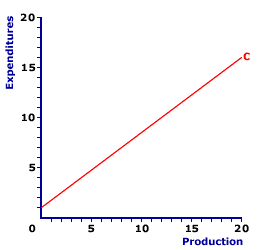
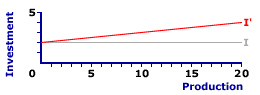
Three ExpendituresThe aggregate expenditures line is the combination of expenditures by the three domestic macroeconomic sectors--household, business, and government. Each of these three sectors is responsible for a specific expenditure on gross domestic product--consumption, investment, and government purchases. And each expenditure is represented by a corresponding expenditure line.
The Three-Sector Line
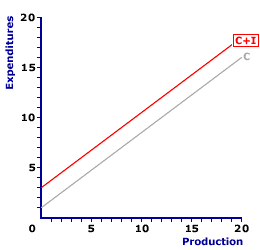
Also included in this exhibit is one gray lines, labeled C. This line represents the sequential stacking of expenditures by the two sectors, beginning with consumption (C), then adding investment for the two-sector aggregate expenditures line (C+I). This particular two-sector aggregate expenditures line assumes that investment expenditures are completely autonomous. This is why all both lines in the exhibit are parallel. The C+I line is parallel to the C line because investment is autonomous and constant at all levels of income and production. Because consumption is the only induced expenditure, which is measured by the marginal propensity to consume, the slopes of both parallel lines are also equal to the marginal propensity to consume. If investment expenditures are assumed to be induced, then the slope of the C+I line will become steeper. Two More LinesThe aggregate expenditures line actually comes in several varieties, depending on how many of the three expenditures are included and whether or not the expenditures are assumed to be induced or autonomous. The three most common aggregate expenditures lines represent the sequential inclusion of the three expenditures, beginning with consumption expenditures and investment expenditures, then adding government purchases and net exports.
Check Out These Related Terms... | aggregate expenditures line | three-sector aggregate expenditures line | four-sector aggregate expenditures line | derivation, aggregate expenditures line | slope, aggregate expenditures line | intercept, aggregate expenditures line | aggregate expenditures determinants | induced expenditures | autonomous expenditures | Or For A Little Background... | macroeconomic sectors | consumption expenditures | investment expenditures | aggregate expenditures | Keynesian economics | macroeconomics | household sector | business sector | national income | gross domestic product | effective demand | psychological law | consumption line | investment line | And For Further Study... | Keynesian model | two-sector Keynesian model | three-sector Keynesian model | four-sector Keynesian model | Keynesian equilibrium | injections-leakages model | two-sector injections-leakages model | three-sector injections-leakages model | four-sector injections-leakages model | aggregate demand | paradox of thrift | fiscal policy | multiplier | Recommended Citation: TWO-SECTOR AGGREGATE EXPENDITURES LINE, AmosWEB Encyclonomic WEB*pedia, http://www.AmosWEB.com, AmosWEB LLC, 2000-2025. [Accessed: December 16, 2025]. |