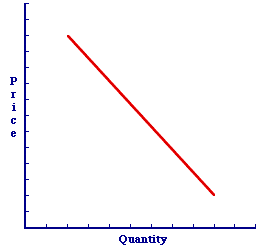
COMPLEMENT-IN-CONSUMPTION: One of two (or more) goods that provide satisfaction of a want or need when consumed together. A complement-in-consumption is one of two alternatives falling within the other prices determinant of demand. The other is a substitute-in-consumption. An increase in the price of one complement good causes a decrease in demand for the other. A complement-in-consumption has a negative cross elasticity of demand.Complements-in-consumption are two or more goods that satisfy wants or needs when consumed jointly. Satisfaction is greater when both goods are consumed together than when they are consumed separately. Buying and consuming either good by itself is not quite as satisfying as both goods combined. In many cases, if both complement goods cannot be consumed, then neither will be purchased. Buy both, or buy neither. The need for food can be satisfied by consuming a hamburger and french fries. The need for transportation can be satisfied by buying a sport utility vehicle and gasoline. The desire to play golf can be satisfied by purchasing golf clubs and golf balls. Satisfaction is less if only one of each pair is consumed. The price of a complement-in-consumption is part of the other prices demand determinant. A change in the price of a complement-in-consumption causes a change in demand and a shift of the demand curve. An increase in the price of one complement good causes a decrease in demand for the other. A decrease in the price of one complement good causes an increase in demand for the other. Shifting the Demand CurveTo illustrate this process consider two bits of complementary sporting equipment--golf clubs and golf balls. While can be used in its own right, when consumed together they enable a satisfying round of golf.
Cross ElasticityClassifying a good as a complement-in-consumption is accomplished in a precise manner using the cross elasticity of demand. The cross elasticity of demand is the relative response of the demand for one good to changes in the price of another good. More specifically, it is the percentage change in the demand of one good due to a percentage change in the rice of another good. A complement-in-consumption is then one with a cross elasticity that is negative, or less than zero. In comparison, an substitute-in-consumption has a positive, or greater than zero, cross elasticity.Check Out These Related Terms... | substitute-in-consumption | complement good | substitute good | complement-in-production | substitute-in-production | other prices, demand determinant | demand determinants | Or For A Little Background... | demand | market demand | demand price | quantity demanded | law of demand | demand curve | change in demand | change in quantity demanded | ceteris paribus | And For Further Study... | market | Marshallian cross | comparative statics | competition | competitive market | consumer surplus | other prices, supply determinant | supply determinants | cross elasticity of demand | Recommended Citation: COMPLEMENT-IN-CONSUMPTION, AmosWEB Encyclonomic WEB*pedia, http://www.AmosWEB.com, AmosWEB LLC, 2000-2025. [Accessed: December 16, 2025]. |