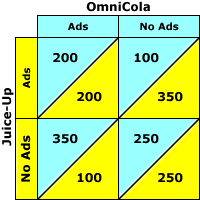
GAME THEORY: An analysis that illustrates how the choices between two players affect the outcomes of a "game." Game theory is commonly used to explain the behavior and decision making of oligopolistic firms. It illustrates that cooperation, rather competition, between two "players" can lead to an outcome that is more beneficial to both players.Game theory is a handy way to analyze the type of interdependence often found with oligopoly. Oligopoly is a market structure containing a small number of large firms that practice competition among the few. The actions of one firm in an oligopoly is likely to prompt counter actions by other firms. One firm lowers its price, prompting a competing firm to lower its price. One firm launches a new advertising campaign, prompting a competing firm to step up its own advertising. The moves and counter moves among oligopoly firms can be analyzed with game theory, developed by John Nash, a Nobel Prize winning economist and mathematician. The standard game theory analysis is based on alternative outcomes that arise given a choice that each of two players face. The key is that the choice made by each player affects the outcome of both players. For example, suppose that Firm A introduces a new product. This act not only affects sales and profit of Firm A, but also the sales and profit of a competitor, Firm B. Competing Firm B, recognizing this fact, is likely to take a counter action, introducing a new product of its own, which affects its sales and profit, but also the sales and profit of Firm A. Much like a game of chess, each firm plans moves and counter moves based on the actions or anticipated actions of competitors. To illustrate game theory, consider how two competing firms in the hypothetical Shady Valley soft drink market engages in a game of advertising. One of the two firms, OmniCola, is considering a new advertising campaign. The question is how might a major competitor, Juice-Up, react to this decision. Juice-Up might choose to counter with an advertising campaign of its own. In particular, suppose each firm is thinking about spending $50 million on advertising. The key to this analysis is that the benefit that each firm derives from its advertising expense depends on the actions of the other firm.
Consider what would seem to be the "best" option, that is, most profitable outcome. If neither firm advertises, then total industry profit is $500--the lower left square. If the two firms had a cooperative arrangement, or collusive agreement, then they would most likely select this outcome. Each avoids the $50 million advertising expense and ends up with $250 million of profit. Each maintains their individual market share and total industry profit is maximized. Both firms are best off if neither advertises. But the firms do not have a collusive arrangement. OmniCola must select an option NOT knowing what Juice-Up will do. Juice-Up must select an option NOT knowing what OmniCola will do. OmniCola must select the outcome that is best for OmniCola regardless of the decision made my Juice-Up. Likewise, Juice-Up must select the outcome that is best for Juice-Up regardless of the decision made my OmniCola. Consider the options facing OmniCola
Juice-Up, however faces EXACTLY the same choice. Regardless of the decision made by OmniCola, Juice-Up is also wise to advertise. Juice-Up generates $100 million more, regardless of the choice made by OmniCola. The end result is that both firms decide to advertise. In so doing, they end up with less profit ($200 million each), than if they had colluded and jointly decided not to advertise ($250 million each). Game theory illustrates the key problem of interdependent decision-making found in oligopoly. Competition among the few can lead to inefficiency and competitive actions that waste resources without generating corresponding benefits. Check Out These Related Terms... | collusion | collusion production analysis | collusion, efficiency | cartel | Or For A Little Background... | oligopoly | oligopoly, characteristics | oligopoly, behavior | merger | imperfect competition | market share | market control | profit maximization | And For Further Study... | kinked-demand curve | kinked-demand curve analysis | barriers to entry | Nobel Prize in Economic Sciences | monopoly, short-run production analysis | monopolistic competition, advertising | firm objectives | Recommended Citation: GAME THEORY, AmosWEB Encyclonomic WEB*pedia, http://www.AmosWEB.com, AmosWEB LLC, 2000-2025. [Accessed: December 16, 2025]. |