INVESTMENT, PRODUCTION POSSIBILITIES: Investment typically refers to the purchase of productive capital by business in anticipation of increasing production and (presumably) generating more profit. More generally, investment can be considered as sacrificing the current satisfaction of wants and needs (consumption goods) to expand productive capability (capital goods). Production possibilities analysis can be used to illustrate the tradeoff between consumption and capital as a movement along a production possibilities curve.Production possibilities, which analyzes the alternative combinations of two goods that an economy can produce with given resources and technology, indicates investment as a movement along the production possibilities curve and the sacrifice of consumption goods for capital goods. Doing InvestmentTo most people the notion of investment probably translates into something like "to invest in the stock market," that is, to buy corporate stock. Similar "investments" might also include investing in "land deals," "oil wells," or "gold futures." These are considered investments because investors hope to get more out than they put in. Of course, there is risk involved. They could get less out than they put in.The economic notion of investment is related to, but slightly different from, this common view. In particular, investment is the acquisition of productive capital goods that are used to expand future production capabilities. Three points need to be noted about the connection between the common view and the economic view of investment.
Production PossibilitiesHow does investment relate to production possibilities?
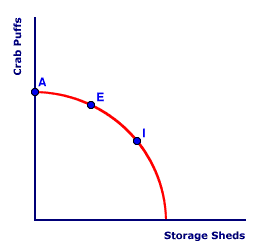
The TradeoffInvestment involves a tradeoff between producing capital goods and consumption goods. Resources used to produce capital goods (which expand the economy's production capabilities and shift out the production possibilities frontier) cannot be used to produce consumer goods (which provide for the immediate satisfaction of wants and needs). This is one of the most fundamental tradeoffs in the economy. To produce more in the future, the economy must accept less satisfaction in the present.The capital-consumption tradeoff can be illustrated with two goods crab puffs and storage sheds. Crab puffs are a consumption good (feeding hungry party guests), and storage sheds are a capital good (often used by businesses to store productive inputs). Selecting an Option
Alternative Shifts
So What?What does this investment tradeoff mean? Scarcity is THE fundamental problem facing the economy. Society has unlimited wants and needs but not enough resources to satisfy them all. What can be done about scarcity? All available resources could be used to satisfy as many wants and needs as possible--right here, right now. This means producing consumption goods. Or society could set aside a few resources to produce capital--the basic act of investment. While this requires sacrificing current satisfaction--right here, right now--it enables more production later. This makes scarcity less of a problem, later.Investing in capital goods (and sacrificing current consumption) expands the production capability of the economy. This is THE source of economic growth and progress. This is THE method of lessening the problem of scarcity. But if a little investment is good, then a lot of investment must be better, right? Not necessarily. Consider an extreme case. Suppose all resources are used to produce capital goods this year. Then next year should see a big boost in economic growth, right? Unlikely! The reason, of course, is that everyone will be dead long before next year begins. With no consumption, people die. The trick is to strike a balance between capital goods and consumption goods. The trick is to sacrifice some today for more tomorrow. But, how much is sacrificed today? That answer is unknown because it requires information about consumer preferences (which is beyond production possibilities analysis) and enters into the realm of normative economics. Check Out These Related Terms... | economic growth, production possibilities | economic growth, sources | full employment, production possibilities | unemployment, production possibilities | derivation, production possibilities curve | slope, production possibilities curve | opportunity cost, production possibilities | law of increasing opportunity cost | Or For A Little Background... | investment | opportunity cost | scarcity | economic growth | production possibilities | production possibilities curve | assumptions, production possibilities | graphical analysis | limited resources | And For Further Study... | economic efficiency | efficiency | economic goals | seven economic rules | free lunch | three questions of allocation | four estates | government functions | political views | technology | investment expenditures | investment business cycles | Recommended Citation: INVESTMENT, PRODUCTION POSSIBILITIES, AmosWEB Encyclonomic WEB*pedia, http://www.AmosWEB.com, AmosWEB LLC, 2000-2025. [Accessed: December 16, 2025]. |