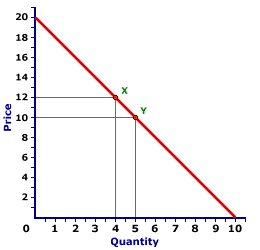
MIDPOINT ELASTICITY FORMULA: A simple technique for calculating the coefficient of elasticity by estimating the average elasticity for discrete changes in two variables. The distinguishing characteristic of this formula is that percentage changes are calculated based on the average of the initial and ending values of each variable, rather than initial values. An alternative technique is the endpoint elasticity formula.The midpoint elasticity formula is a common method of calculating elasticity, especially the price elasticity of demand, price elasticity of supply, income elasticity of demand, and cross elasticity of demand. This formula is most often used at the introductory level of economic instruction. The FormulaThe midpoint elasticity formula for calculating the response of changes in B to changes in A is given as:The first term on the right-hand side of the equation is the percentage change in variable B. The second term is the percentage change in variable A. The individual items are interpreted as this: A1 is the initial value of A before any changes, A2 is the ending value after A changes, B1 is the initial value of B before any changes, and B2 is the ending value after B changes. The numerator of each term on the right-hand side of the equation [(A2 - A1) and (B2 - B1)] is the discrete change in A and B, respectively. The denominator of each term [(A2 + A1)/2 and (B2 + B1)/2] is the base value from which the percentage change is calculated. A Special PercentageThese base values and the resulting percentage changes are unlike traditional methods of calculating percentage changes. For example, under traditional methods a price that rises from $10 to $12 is a 20 percent increase. This is calculated as the discrete change in price of $2 (= $12 - $10), divided by the initial value of $10. However, using the midpoint approach, the discrete change is still $2 (= $12 - $10), but instead of using the initial value of $10, the base value is the average of $10 and $12, that is $11 [= ($10 + $12)/2]. This approach results in percentage change of 18.18 percent.While this seems like another example of making a simple task excessively complicated, such is not the case. This is actually intended to generate identical elasticity calculations over a given segment of a curve, whether the variables increase or decrease. This is particularly important for the demand curve and the price elasticity of demand. An Simple Example
Or is it? What is the coefficient of elasticity for this same range of the demand curve, if the price DECREASES from $12 to $10 causing the quantity demanded to increase from 4 to 5? In this case, the change in price is 16.7 percent, a $2 decrease from an $12 initial price, and the change in quantity is 25, an increase of 1 Stuffed Amigo from an initial value of 4. This results in a coefficient of elasticity of 1.5. Over the same segment of the demand curve, a price INCREASE indicates a different coefficient of elasticity than does a price DECREASE. This can become confusing, which is where the midpoint formula comes into play. Using the Midpoint FormulaUsing the midpoint formula, a price increase from $10 to $12 gives a change of 18.18 percent, a $2 increase from a midpoint base of $11 [= ($12 + $10)/2]. This is the same 18.18 percent change for a price decrease from $12 to $10. The resulting quantity change between 4 and 5 gives the same percentage change of 22.22 percent, a change of 1 Stuffed Amigo from an midpoint base of $4.5 [= ($4 + $5)/2], whether quantity is increasing from 4 to 5 or decreasing from 5 to 4. As such, the price elasticity of demand is 1.22 regardless of the direction of the price and quantity changes.Alternative SpecificationsOne alternative method of specifying the midpoint elasticity formula can be had by eliminating the "/2" from both the numerator and denominator terms on the right-hand side of the equation. Eliminating this unneeded step results in a formula of:Another variation of this midpoint formula is possible by rearranging terms slightly, resulting in: Both of these alternatives are designed to ease the calculation process just a little. And all three formulas produce identical results. Moreover, for increasingly small changes in the two variables A and B, the midpoint elasticity formula more closely approximates point elasticity. Check Out These Related Terms... | endpoint elasticity formula | coefficient of elasticity | point elasticity | arc elasticity | Or For A Little Background... | elasticity | price elasticity of demand | price elasticity of supply | income elasticity of demand | cross elasticity of demand | And For Further Study... | elasticity and demand slope | elasticity and supply intercept | demand elasticity and total expenditure | elasticity alternatives | elasticity determinants | utility analysis | short-run production analysis | Recommended Citation: MIDPOINT ELASTICITY FORMULA, AmosWEB Encyclonomic WEB*pedia, http://www.AmosWEB.com, AmosWEB LLC, 2000-2025. [Accessed: December 16, 2025]. |