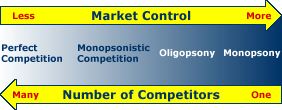
MONOPSONY: A market characterized by a single buyer of a product. Monopsony is the buying-side equivalent of a selling-side monopoly. Much as a monopoly is the only seller in a market, monopsony is the only buyer. While monopsony could be analyzed for any type of market it tends to be most relevant for factor markets in which a single firm is the only buyer of a factor. Two related buying side market structures are oligopsony and monopsonistic competition.Monopsony is a market in which a single buyer completely controls the demand for a good. While the market for any type of good, service, resource, or commodity could, in principle, function as monopsony, this form of market structure tends to be most pronounced for the exchange of factor services. While the real world does not contain monopsony in its absolute purest form, labor markets in which a single large factory is the dominate employer in a small community comes as close as any. Like a monopoly seller, a monopsony buyer is a price maker with complete market control. Monopsony is also comparable to monopoly in terms of inefficiency. Monopsony does not generate an efficient allocation of resources. The price paid by a monopsony is lower and the quantity exchanged is less than with the benchmark of perfect competition. CharacteristicsThe three key characteristics of monopsony are: (1) a single firm buying all output in a market, (2) no alternative buyers, and (3) restrictions on entry into the industry.
A Hypothetical ExampleOne example of a monopsony factor market is the hypothetical Natural Ned Lumber Company, which is a lumbering operation in the isolated Jagged Mountains region north of the greater Shady Valley metropolitan area. The Natural Ned Lumber Company is an expansive operation employing several thousand workers, all of whom reside in Lumber Town, which is adjacent to the Natural Ned Lumber Company lumbering operations. In fact, everyone living in Lumber Town works for the Natural Ned Lumber Company.This makes the Natural Ned Lumber Company a monopsony employer. If anyone in Lumber Town seeks employment, then they must seek it with the Natural Ned Lumber Company. As such, the Natural Ned Lumber Company is a price maker when it comes to buying labor services. The Natural Ned Lumber Company can the determine of labor services desired, then charge the minimum factor price that sellers are willing and able to receive. While the Natural Ned Lumber Company and Lumber Town is obviously a fictitious example of a monopsony, it does illustrate one of the more prevalent categories of monopsony that existed in the early history of the U.S. economy--the company town. During the early days of the U.S. industrial revolution, the late 1800s through the early 1900s, it was quite common for a large industrial facility (factory, mining operation, lumber company) to dominate employment in a given area. In some cases, the company literally built and owned the town in which the workers lived. Even those people who did not work directly in the primary activity (mining, lumber, etc.) worked in the company-owned store, hospital, school, or theater. Hence the term company town. Modern MonopsonyLike other extreme market structures (perfect competition and monopoly) monopsony is only approximated in the real world. Achieving the status of THE ONLY BUYER is not easy. Few if any buyers actually achieve this status. However, several have come close. In modern times a few examples of markets that come very close to monopsony come from the world of sports.Should a talented quarterback wish to obtain a job as a professional football player, then THE employer is the National Football League (NFL). Of course, the NFL is not absolutely the ONLY employer. Employment as a professional football player can also be found with the Canadian Football League (CFL). However, sufficient difference exists between these two employers to give the NFL significant monopsony control. Similar near monopsony status exists for other professional sports. A professional baseball player seeks employment with Major League Baseball (MLB), with minimal competition from Japan. A profession basketball player seeks employment with the National Basketball Association (NBA), with minimal competition from Europe. A profession hockey player seeks employment with the National Hockey League (NHL), again with some competition from Europe. Other modern markets that exhibit varying degrees of monopsony status can be found in collegiate sports and the National Collegiate Athletic Association (NCAA) and the medical profession and the American Medical Association (AMA). Much like a professional football, baseball, basketball, or hockey player seeks employment in the "big leagues," a collegiate athlete seeks "employment" with a college affiliated with the NCAA. In a similar manner, a physician seeks "employment" through the AMA. The reasons for quotation marks around employment for these two examples is that the monopsony employer does not technically employ these workers in a traditional sense. Monopsony status, however, is attributable to the ability to influence the factor market. In other words, a collegiate athlete who does not satisfy NCAA guidelines has difficulty "working" for a university, that is providing athletic entertainment services through the college in return for a scholarship. A physician who does not satisfy AMA guidelines also has difficulty working at a hospital or in private practice. Supply and Cost
The far right curve in the exhibit is the red supply curve (S) facing the monopsony. The far left curve is the brown marginal factor cost curve (MFC). The marginal factor cost curve indicates the change in total factor cost incurred due to buying one additional unit of the good. Because a monopsony is a price maker with extensive market control, it faces a positively-sloped supply curve. To buy a larger quantity of output, it must pay a higher price. For example, the monopsony can hire 10,000 workers for a wage of $5. However, if it wants to hire 20,000 workers, then it must raise the wage to $6.10. For this reason, the marginal factor cost incurred from hiring extra workers is greater than the wage, or factor price. Suppose for example that the factor price needed to hire ten workers is $5 and the factor price needed to hire eleven workers is $5.10. The marginal factor cost incurred due to hiring the eleventh unit is $6.10. While the $6 factor price means the monopsony incurs a $5.10 factor cost from hiring this worker, this cost is compounded by an extra cost of $1 due to the higher wage paid to the first ten workers. The overall increase in cost, that is marginal factor cost, is thus $6.10 (= $5.10 + $1). Profit Maximizing Employment
As a profit-maximizing firm, monopsony hires the quantity that equates marginal factor cost and marginal revenue product found at the intersection of the MFC and MRP curves. This quantity is 37,000 workers. The monopsony then pays each worker $8.40. This price and quantity maximizes profit because the revenue generated from hiring the last worker (marginal revenue product) is exactly equal to the cost incurred from hiring the last worker (marginal factor cost). Because the extra revenue generated equals the extra cost incurred, there is no way to increase profit by hiring more or less of this input. The Other Three Market Structures
Check Out These Related Terms... | oligopsony | monopsonistic competition | bilateral monopoly | monopoly | monopsony, efficiency | monopsony, minimum wage | monopsony, factor market analysis | Or For A Little Background... | factor market analysis | factor demand | factor supply | marginal factor cost | marginal factor cost curve, monopsony | profit maximization | efficiency | barriers to entry | market control | market structures | And For Further Study... | perfect competition, factor market analysis | bilateral monopoly, factor market analysis | factor market, efficiency | compensating wage differentials | monopoly, short-run production analysis | Recommended Citation: MONOPSONY, AmosWEB Encyclonomic WEB*pedia, http://www.AmosWEB.com, AmosWEB LLC, 2000-2025. [Accessed: December 15, 2025]. |