PRODUCT MARKETS: Markets that exchange final goods and services, that is, the output that is combined into gross domestic product. The buyers of this production are the four macroeconomic sectors--household, business, government, and foreign. The seller of this production is primarily the business sector. A substantial part of macroeconomics is devoted to explaining how and why gross domestic product exchanged through product markets rises or falls. Product markets, also termed output or goods markets, are one of three primary sets of macroeconomic markets. The other two are resource markets and financial markets.Product markets take center stage in the macroeconomic analysis of the economy. First and foremost, product markets provide a direct indication of the level of aggregate output, or gross domestic product. This also suggests how and why the level of aggregate output changes as the economy moves through the ups and downs of business cycles. Furthermore, the product markets indirectly shed a little light on the macroeconomic problems of inflation and unemployment. Gross ProductionThe product markets exchange final goods and services, what is commonly specified as gross domestic product. Definitionally speaking, gross domestic product is the total market value of all final goods and services produced in the domestic economy over a given period.The product markets only exchange final production. They exclude raw materials or intermediate goods that are subject to further processing before resold. They also exclude the services of the factors of production, which are exchanged through the resource markets, and financial assets, which are exchange through the financial markets. Buyers and SellersThe demand side of the product markets is commonly and conveniently categorized by the particular macroeconomic sector making the expenditure--household, business, government, and foreign. The corresponding expenditures made by these four sectors are consumption expenditures, investment expenditures, government purchases, and exports.
One of ThreeThe product markets are one of three groups of macroeconomic markets. The other two are resource and financial.
The Circular Flow
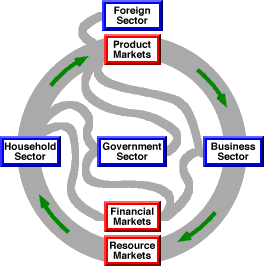
A basic representation of the circular flow is displayed to the right. The four components of this simple model are: household sector, business sector, product markets, and resource markets. The household sector at the far left contains the consuming population of the economy. The business sector at the far right includes all of the producers. The product markets at the top of the flow direct production from the business sector to the household sector in exchange for payment flowing in the opposite direction. The resource markets at the bottom of the flow direct factor services from the household sector to the business sector in exchange for payment flowing in the opposite direction. The circular flow indicates that the income used by the household sector to purchase goods through the product markets is obtained by selling factor services through the resource markets. It also indicates that the revenue used by the business sector to pay for factor services obtained through the resource markets is generated by selling goods through the product markets. Aggregate EquilibriumIt is often convenient to combine the thousands of individual microeconomic product markets used to exchange a wide assortment of final goods and services throughout the economy into an abstract aggregation. Demand in the aggregate product market reflects the expenditures made by buyers in the individual markets. And supply in the aggregate product market reflects the total production sold in the individual markets.Equilibrium in the aggregate product market is an essential aspect of macroeconomic analysis. In particular, overall macroeconomic equilibrium, which includes both short-run equilibrium and long-run equilibrium, requires aggregate product market equilibrium. This exists if total expenditures on gross domestic product is equal to the total amount of gross domestic product available. However, this does not mean every individual product market is in equilibrium. One might have a bit of a shortage and another a bit of a surplus. As long as the shortages and surpluses balance out, meaning aggregate production is equal to aggregate expenditures, then the aggregate product market is in equilibrium Check Out These Related Terms... | macroeconomic markets | financial markets | resource markets | Or For A Little Background... | macroeconomics | market | demand | supply | macroeconomic goals | production | government functions | factors of production | abstraction | microeconomics | equilibrium | And For Further Study... | business cycles | inflation | unemployment | macroeconomic sectors | household sector | business sector | government sector | foreign sector | circular flow | economic system | capitalism | macroeconomic problems | macroeconomic theories | shortage | surplus | Recommended Citation: PRODUCT MARKETS, AmosWEB Encyclonomic WEB*pedia, http://www.AmosWEB.com, AmosWEB LLC, 2000-2025. [Accessed: December 15, 2025]. |