TOTAL PRODUCT: The total quantity of output produced by a firm for a given quantity of inputs. Total product is the foundation upon which the analysis of short-run production for a firm is based. The usual framework is to analyze total product when a variable input (labor) changes, while a fixed input (capital) does not change. Two related concepts derived from total product are average product and marginal product.Total product is the overall quantity of output that a firm produces, usually specified in relation to a variable input. Total product is the starting point for the analysis of short-run production. It indicates how much output a firm can produce according to the law of diminishing marginal returns. Total Taco Production
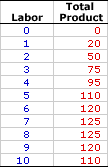
The column on the left is the variable input, specifically the number of workers employed by Waldo's TexMex Taco World, which ranges from 0 to 10. While the number of workers is variable, the quantity of capital, specifically the restaurant associated equipment, is fixed. The column on the right is the total product, the total number of TexMex Gargantuan Tacos produced each hour. Total product, Gargantuan Taco production, ranges from a low of 0 to a high of 125. Note that 125 TexMex Gargantuan Tacos is NOT that production achieved with all 10 workers, but rather the production for either 7 or 8 workers. Maximum production does NOT necessarily result from maximum use of the variable input. What other sorts of observations can be made about this table?
Two Production RulesThese total Gargantuan Taco production numbers suggest two notable short-run production rules:
The Law of Diminishing Marginal ReturnsTotal product does not increase in a linear fashion due to the law of diminishing marginal returns. This law states that as more of a variable input is added to a fixed input in short-run production, then the marginal product (that is, the marginal returns) of the variable input eventually declines.For example, the second employee of Waldo's TexMex Taco World might increase taco production from 20 to 50 (a change of 30 tacos), the sixth worker increases production only from 110 to 120 (a change of 10 tacos). The Total Product Curve
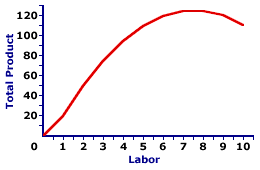
The "overall" slope of this curve is positive, with extra workers "generally" leading to greater production. However, the curve has a distinctive shape, emerging steeply from the origin, then flattening, and eventually declining. The shape of this curve is attributable to the law of diminishing marginal returns. Consistent with the numbers in the table, the curve reaches a peak of 125 Gargantuan Tacos at both 7 and 8 workers. To the left of this peak of 125 Gargantuan Tacos, extra workers increase the production and to the right of the peak extra workers actually reduce total taco production. Average and MarginalTwo related product measures are derived directly from total product--average product and marginal product.
Check Out These Related Terms... | marginal product | average product | total product curve | marginal product curve | average product curve | production function | law of diminishing marginal returns | marginal returns | production stages | Or For A Little Background... | short-run production analysis | production | production cost | variables | labor | capital | supply | principle | business | economic analysis | marginal analysis | factors of production | microeconomics | And For Further Study... | long-run production analysis | production possibilities | production inputs | production time periods | total product and marginal product | total product and average product | average product and marginal product | total cost | total utility | total variable cost | total variable cost and total product | total physical product | Recommended Citation: TOTAL PRODUCT, AmosWEB Encyclonomic WEB*pedia, http://www.AmosWEB.com, AmosWEB LLC, 2000-2025. [Accessed: December 16, 2025]. |