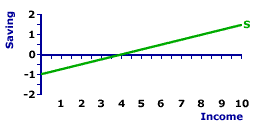
AUTONOMOUS SAVING: Household saving that does not depend on income or production (especially disposable income, national income, or even gross domestic product). That is, changes in income do not generate changes in saving. Autonomous saving is best thought of as a baseline level of saving (usually negative) that the household sector undertakes in the unlikely event that income falls to zero. It is measured by the intercept term of the saving function or the saving line. The alternative to autonomous saving is induced saving, which does depend on income.Autonomous saving is saving by the household sector that is unrelated to and unaffected by the level of income or production. This is one of two basic classifications of saving. The other is induced saving, saving that is based on the level of income or production. In other words, household saving can be divided into: (1) a baseline amount of saving which, in theory, would be undertaken even if the household sector had no income and (2) additional saving that results from the income available to the household sector. The bulk of saving falls in the induced category because people are prone to base saving on available income. However, some saving (actually negative saving) takes place independent of income. Autonomous saving generally surfaces primarily as a theoretical extreme, at least for the aggregate household sector--the amount of saving undertaken in the unlikely event that household sector income is zero. However, it does have a pragmatic interpretation, especially for individuals. A typical consumer such as Pollyanna Pumpernickel is bound to base personal saving on available income. However, should Pollyanna's income fall to zero (perhaps due to a temporary bout of unemployment), then her saving is bound to fall. In fact, it is likely to fall so much that it turns negative as Pollyanna's consumption exceeds income. That is, she probably finds it necessary to withdraw previously accumulated saving to meet her expenses. This is Pollyanna's autonomous saving. Autonomous In An EquationOne way to illustrate autonomous saving is with the saving function, such as the equation presented here:where: S is saving, Y is income (national or disposable), c is the intercept, and d is the slope. The two key parameters that characterize the saving function are slope and intercept. Autonomous saving is indicated by the intercept of the saving function. Induced saving is indicated by the slope.
where: C is consumption expenditures, Y again is income, a is the intercept, and b is the slope. Because income not spent is saved, the saving function can be specified as: where: S is saving and Y is income. However, now the intercept is -a rather than c and the slope is (1-b) rather than d. This alternative specification shows the connection between the saving function and the consumption function. The intercept of the saving function (-a) is the negative of the intercept of the consumption function (a). Autonomous In A Line
The two primary characteristics of the saving function--slope and intercept--are also identified by the saving line.
Consumption Expenditures DeterminantsThis is a good place to make note of factors other than income that also affect saving. While income is THE most important influence on saving, interest rates, consumer confidence, and wealth are among other important influences--officially termed consumption expenditures determinants.These determinants, similar to those for other relations in the study of economics, while primarily specified as determinants of consumption expenditures also cause a change in the underlying saving-income relation. From a graphical perspective, these determinants cause the saving line to shift, which effectively means that the intercept of this line changes. More generally, these determinants cause a change in autonomous saving. A decrease in interest rates, a boost in consumer confidence, or an increase in financial wealth, for example, all trigger an decrease in saving... even though income remains unchanged. Other Autonomous ExpendituresSaving is only one of several autonomous variables that enters into the study of Keynesian economics. Of course, the complement of saving, consumption, is also an important autonomous variable. The other three aggregate expenditures--investment expenditures, government purchases, and net exports--also have important autonomous components. In fact, the autonomous components of these other expenditures are often more important in Keynesian economics than autonomous consumption or saving.
Check Out These Related Terms... | induced saving | saving function | saving line | marginal propensity to save | autonomous consumption | autonomous expenditures | autonomous investment | autonomous government purchases | autonomous net exports | intercept, saving line | slope, saving line | effective demand | psychological law | injections | leakages | Or For A Little Background... | Keynesian economics | circular flow | aggregate expenditures | saving | consumption | consumption expenditures | personal consumption | macroeconomics | household sector | disposable income | national income | gross domestic product | business cycles | determinants | And For Further Study... | aggregate expenditures line | average propensity to save | derivation, saving line | derivation, consumption line | consumption expenditures determinants | Keynesian model | Keynesian equilibrium | injections-leakages model | aggregate demand | paradox of thrift | fiscal policy | multiplier | Recommended Citation: AUTONOMOUS SAVING, AmosWEB Encyclonomic WEB*pedia, http://www.AmosWEB.com, AmosWEB LLC, 2000-2025. [Accessed: December 15, 2025]. |