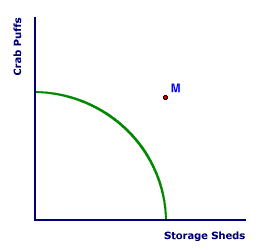
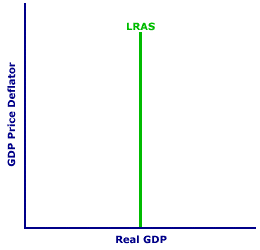
ECONOMIC GROWTH: The long-run expansion of the economy's ability to produce output. Growth is attained by increasing the quantity or quality of the economy's resources--labor, capital, land, and entrepreneurship--through such things as population growth, investment, exploration, technological innovation, and education. This is one of the five economic goals and more specifically one of the three macroeconomic goals. The other goals are full employment, stability, efficiency and equity.Economic growth is achieved by increasing the economy's ability to produce goods and services. This goal is best indicated by measuring the growth rate of production. If the economy produces more goods this year than last, then it is growing. Economic growth is also indicated by increases in the quantities of the resources--labor, capital, land, and entrepreneurship--used to produce goods. With economic growth, society gets more goods that can be used to satisfy more wants and needs--people are better off; living standards rise; and scarcity is less of a problem. Graphical Indications
Sources of Economic GrowthAn economy is able to achieve the goal of economic growth by increasing the quantity or quality of the resources. Consider a few of the more important examples.
InvestmentEconomic growth can be achieved in several different ways. However, each method involves the fundamental process of investment. Investment is the sacrifice of current benefits or rewards to pursue an activity with expectations of greater future benefits or rewards. In its simplest form investment means giving up consumption goods and producing capital goods.The quantity and quality sources of economic growth all involve investment in one way or another. Increasing the quantity of capital is an obvious example. Exploration for natural resources, such as drilling for oil, also fits most common sense notions of investment. However, increasing in the quantity of labor also reflects investment. Parents sacrifice their own consumption to raise a family. Immigrants sacrifice as they travel to a new country. The acquisition of education is also an investment, exemplified by college students who sacrifice four to five years of early adulthood for a college degree. The development of technology is also an investment with resources devoted to scientific research rather than being used for other production. The bottom line is that economic growth is achieved through investment. Without investment, there is no economic growth. The Problems of Economic GrowthThe macroeconomic goal of economic growth is generally acknowledged as a beneficial pursuit. Almost everyone gains from economic growth. Unlike other economic goals, conservatives and liberals usually agree that economic growth is good for society.However, everything has a down side and economic growth is no exception.
Check Out These Related Terms... | macroeconomic goals | full employment | stability | microeconomic goals | efficiency | equity | scarce resources | Or For A Little Background... | economic goals | scarcity | resources | economic system | mixed economy | And For Further Study... | specialization | liberal | conservative | political views | government functions | economic growth, production possibilities | economic growth, sources | investment, production possibilities | production possibilities | production possibilities curve | investment | business cycles | gross domestic product | labor force participation rate | structural unemployment | aggregate market | aggregate supply increase, long-run aggregate market | aggregate supply determinants | capital stock, aggregate supply determinant | Recommended Citation: ECONOMIC GROWTH, AmosWEB Encyclonomic WEB*pedia, http://www.AmosWEB.com, AmosWEB LLC, 2000-2025. [Accessed: December 16, 2025]. |