EXPANSION: A phase of the business cycle characterized by a general period of rising economic activity. An expansion is one of two basic business cycle phases. The other is contraction. The transition from expansion to contraction is termed a peak and the transition from contraction to expansion is termed a trough. The early phase of an expansion is commonly termed a recovery.A business-cycle expansion is a general increase in economic activity, so named because the aggregate economy is "expanding" or growing bigger. An expansion is often considered the "normal" state of the economy, resulting from ongoing attempts to address the scarcity problem, made possible by increasing the quantity and quality of the resources. The study of macroeconomics centers on policies that promote expansions. Making it OfficialThe onset and length of an expansion is officially tracked by the official trackers at the National Bureau of Economic Research.Expansions last, on average, about 3-4 years, but this is by no means guaranteed. One expansion in the early 1980s lasted a mere 12 months. The next expansion then lasted over 8 years. Much of the 1990s was dedicated to a 120-month, 10-year expansion. Newspeople, political leaders, and economists are prone to call the early part of an expansion a recovery. During this period, the economy is picking up the pace after a contraction, but it has not yet returned to the pre-contraction level of economic activity. While expansions are frequently indicated by an increase of real gross domestic product, they also show up in many aggregate measures of economic activity. A big one is the unemployment rate, which typically declines, approaching the full employment level of about 5%, if not lower. The inflation rate also tends to rise, especially during the latter stages of an expansion. Aggregate expenditures on gross domestic product, especially investment and to a lesser degree consumption, also increase. A Graphical Upturn
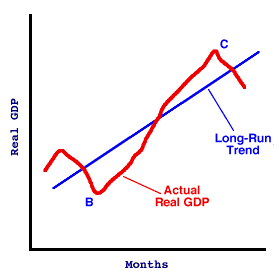
Click the [Expansion] button to highlight the expansion phase of this business cycle. The shaded segment of the real GDP line between points B and C is the expansion. Clearly real GDP rises over this segment. An expansion generally takes the economy from below the long-run trend to at or above the long-run trend. The early part of an expansion is usually termed a recovery because the economy is "recovering" from a contraction. Because the long-run trend represents full employment, when real GDP reaches the long-run trend, when actual real GDP is equal to potential real GDP, then the economy has full employment. Inflation problems, however, arise when actual real GDP exceeds potential real GDP, as is the case in this diagram near point C. In addition, the more real GDP rises above the long-run trend, then the greater inflation problems are likely to be. The Bad with the GoodGenerally speaking, life is grand during a business-cycle expansion. The economy is growing. More goods are produced. Resources are employed. People are happily satisfying their wants and needs. Living standards rise. Businesses are profitable. Expansions tend to be the best of times. Expansions are what the economy seeks in the never-ending pursuit of satisfying unlimited wants and needs with limited resources. But even during expansionary good times, there are bads.
Contractionary PoliciesContractionary policies are appropriate when a business-cycle expansion heats up to the point of higher inflation. The two types are contractionary fiscal policy and contractionary monetary policy.
Check Out These Related Terms... | business cycles | business cycle phases | contraction | peak | trough | recovery | recession | potential real gross domestic product | long-run trend | Or For A Little Background... | macroeconomics | macroeconomic goals | mixed economy | economic analysis | production possibilities | efficiency | And For Further Study... | business cycle indicators | investment business cycles | political business cycles | demand-driven business cycles | supply-driven business cycles | stabilization policies | unemployment | inflation | Recommended Citation: EXPANSION, AmosWEB Encyclonomic WEB*pedia, http://www.AmosWEB.com, AmosWEB LLC, 2000-2025. [Accessed: December 16, 2025]. |