CONTRACTION: A phase of the business cycle characterized by a general period of declining economic activity. A contraction is one of two basic business cycle phases. The other is expansion. The transition from contraction to expansion is termed a trough and the transition from expansion to contraction is termed a peak. The popular term for contraction, one that frequently shows up in the media, is recession.A business-cycle contraction is a general downturn in economic activity, so named because the aggregate economy is "contracting" or growing smaller. A contraction is the seemingly inevitable phase of the business cycle that sets in after the economy has been expanding for several years. A primary goal of macroeconomics is to explain why contractions occur and then to recommend what policies can prevent them. Making if OfficialA contraction is officially designated, by the official designators at the National Bureau of Economic Research, as at least six months of declining economic activity. Six months is used because anything less is likely to be just a temporary, inconsequential blip in the data. And because many indicators are reported quarterly (that is, every three months), two straight quarters of declining activity is a good indication of an economic slowdown.Although six months is the minimum time needed for a contraction to be official, they typically last for about a year and often persist for up to eighteen months. The longest contraction on record continued for 43 months from August 1929 to march 1933 during the first few years of the Great Depression. In fact, in the minds of many, the contraction from 1929 to 1933 WAS the Great Depression. However, the Great Depression also contained a second, shorter contraction of 13 months from May 1937 to June 1938. While contractions are frequently indicated by a decline of real gross domestic product of about 10 percent, they also show up in many aggregate measures of economic activity. The unemployment rate rises above the full employment level of 5 percent, generally reaching at least 6 percent, but also going as high as 10 percent. The inflation rate tends to be lower during a contraction. Aggregate expenditures on gross domestic product, especially investment and to a lesser degree consumption, also decline. A Graphical Downturn
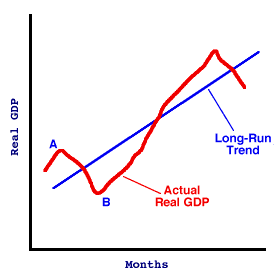
Click the [Contraction] button to highlight the contraction phase of this business cycle. The shaded segment of the real GDP line between points A and B is the contraction. Clearly real GDP declines over this segment. A contraction generally takes the economy from at or above the long-run trend to below the long-run trend. Because the long-run trend represents full employment, unemployment results when real GDP is below the long-run trend, or when actual real GDP is less than potential real GDP. Moreover, the lower real GDP dips below the long-run trend, then the greater is unemployment. The Good with the BadContractions are generally considered obstacles along the path of rising prosperity and rising living standards. The perpetual problem of scarcity is better addressed when the economy expands. Contractions definitely have a number of "bads" that are best avoided. Here are a few worth noting:
However, as any optimist knows, there is a little good in all things, including contractions.
Expansionary PoliciesExpansionary policies are designed to counter business-cycle contractions. The two most common are expansionary fiscal policy and expansionary monetary policy.
Check Out These Related Terms... | business cycles | business cycle phases | expansion | peak | trough | recovery | recession | potential real gross domestic product | long-run trend | Or For A Little Background... | full employment | macroeconomics | macroeconomic goals | mixed economy | economic analysis | production possibilities | unemployment rate | inflation rate | real gross domestic product | full employment | investment | And For Further Study... | business cycle indicators | investment business cycles | political business cycles | demand-driven business cycles | supply-driven business cycles | stabilization policies | National Bureau of Economic Research | multiplier principle | aggregate market | aggregate demand decrease, short-run aggregate market | Keynesian economics | fiscal policy | monetary economics | monetary policy | Recommended Citation: CONTRACTION, AmosWEB Encyclonomic WEB*pedia, http://www.AmosWEB.com, AmosWEB LLC, 2000-2025. [Accessed: December 16, 2025]. |