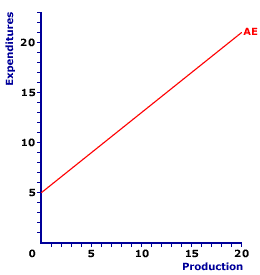
FEDERAL DEFICIT, AGGREGATE EXPENDITURES DETERMINANT: One of several specific aggregate expenditures determinants assumed constant when the aggregate expenditures line is constructed, and that shifts the aggregate expenditures line when it changes. An increase in the federal deficit causes an increase (upward shift) of the aggregate expenditures line. A decrease in the federal deficit causes a decrease (downward shift) of the aggregate expenditures line. Other notable aggregate expenditures determinants include consumer confidence, financial wealth, inflationary expectations, and exchange rates.The federal deficit is the excess of federal government spending over tax collections. The flip side of the federal deficit is the less common federal surplus, the excess of tax collections over spending. A key aspect of the expenditures part of the federal deficit is government purchases, which are one of the four aggregate expenditures. The other aspect of expenditures are transfer payments. Transfer payments add to household disposable income, the income that is used for consumption expenditures. The tax side of the federal deficit reduces that disposable income that the household sector uses for consumption expenditures. Key to changes in the federal deficit is fiscal policy. This is changes in government spending and/or taxes for the expressed purpose of limiting business-cycle instability and reducing the rates of inflation and unemployment. Two types of fiscal policy are worth noting--expansionary and contractionary.
What It Does
A Bigger Federal DeficitSuppose, for example, that Congress decides to undertake a major spending program, such as a build-up of national defense, at the same time it implements a substantial reduction in income taxes. This simultaneous spending boost and tax reduction is just the sort of thing Congress is prone to do because it makes voters happy and keeps the politicians in elected office. It might also be aimed at stimulating the economy out of a business-cycle contraction. The net result of these actions is an increase in the federal deficit, or in the highly unlikely event that one exists, the federal surplus decreases.The increase in the government purchases used to build up national defense works directly to increase aggregate expenditures. This is reinforced by the tax reduction, which adds disposable income to the household sector. This extra income is use largely for consumption expenditures. To see how a bigger federal deficit affects the aggregate expenditures line, click the [Bigger Deficit] button. The greater deficit triggers an increase in aggregate expenditures, which is a upward shift of the aggregate expenditures line. A Smaller Federal DeficitAlternatively, Congress might decide that the federal deficit is too large and acts to trim it back by decreasing assorted expenditures are assorted programs, including education and highway construction, at the same a income taxes are increased. It might also be aimed at fighting inflation associated with a business-cycle expansion that is expanding too much. The net result of these actions is a decrease in the federal deficit, or in the highly unlikely event that one exists, the federal surplus increases..The decrease in the government purchases used for education and highway construction works directly to decrease aggregate expenditures. This is reinforced by the tax increase, which reduces disposable income. The household sector responds to this income decrease, in part, by reducing consumption expenditures. To see how a smaller federal deficit affects the aggregate expenditures line, click the [Smaller Deficit] button. The smaller deficit generates a decrease in aggregate expenditures, which is a leftward shift of the aggregate expenditures line. What Does It Mean?The importance of the federal deficit as an aggregate expenditures determinant is critical to the study of macroeconomics, especially fiscal policy designed to stabilize business cycles. A frequently recommended solution to business-cycle contractions is expansionary fiscal policy, consisting of increased government spending (government purchases or transfer payments) and/or decreased taxes. The net result of this policy action is to increase the federal deficit (or reduce a federal surplus if one should exist).Alternatively, a solution to business-cycle expansions that might be causing inflation is contractionary fiscal policy, consisting of decreased government spending (government purchases or transfer payments) and/or increased taxes. The net result of this policy action is to decrease the federal deficit (or increase a federal surplus if one should exist). When these policies are implemented, the aggregate expenditures line shifts, which then induces changes in production, unemployment, and the price level. Check Out These Related Terms... | aggregate expenditures determinants | interest rates, aggregate expenditures determinant | financial wealth, aggregate expenditures determinant | inflationary expectations, aggregate expenditures determinant | exchange rates, aggregate expenditures determinant | physical wealth, aggregate expenditures determinant | consumer confidence, aggregate expenditures determinant | change in aggregate expenditures | change in aggregate demand | slope, aggregate expenditures line | intercept, aggregate expenditures line | Or For A Little Background... | aggregate expenditures | aggregate expenditures line | determinants | gross domestic product | consumption expenditures | investment expenditures | government purchases | net exports | taxes | Keynesian economics | effective demand | psychological law | And For Further Study... | aggregate market analysis | business cycles | circular flow | monetary economics | Keynesian model | Keynesian equilibrium | injections-leakages model | aggregate demand | aggregate expenditures determinants | fiscal policy | multiplier | monetary policy channels | federal deficit, aggregate demand determinant | Recommended Citation: FEDERAL DEFICIT, AGGREGATE EXPENDITURES DETERMINANT, AmosWEB Encyclonomic WEB*pedia, http://www.AmosWEB.com, AmosWEB LLC, 2000-2025. [Accessed: December 15, 2025]. |