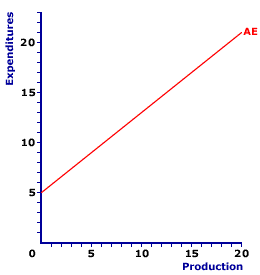
FINANCIAL WEALTH, AGGREGATE EXPENDITURES DETERMINANT: One of several specific aggregate expenditures determinants assumed constant when the aggregate expenditures line is constructed, and that shifts the aggregate expenditures line when it changes. An increase in financial wealth causes an increase (upward shift) of the aggregate expenditures line. A decrease in financial wealth causes a decrease (downward shift) of the aggregate expenditures line. Other notable aggregate expenditures determinants include consumer confidence, federal deficit, inflationary expectations, and exchange rates.The wealth of the economy comes in two basic forms--physical wealth and financial wealth. Financial wealth includes money, bank accounts, stock certificates, bonds, and other financial instruments that provide direct or indirect claims on physical goods. Physical wealth consists of houses, cars, buildings, land, property, equipment, furniture, appliances, and the whole array of tangible goods. The key with financial wealth is that it can be used to acquire physical wealth. In financial lingo, financial wealth tends to be liquid, it can easily flow between assets. Corporate stock, government savings bonds, and money market bank accounts can all easily flow into money. This money can then flow into, or be used to buy, corporate stock, government savings bonds, and money market bank accounts. Or, more importantly for this present discussion, this financial wealth can flow into, or be used to buy, physical wealth, including houses, cars, buildings, land, property, equipment, furniture, appliances, and the whole array of tangible goods. That is, the financial wealth can be used for aggregate expenditures, especially consumption expenditures and investment expenditures. Changes in financial wealth, as such, tend to cause consumption expenditures and investment expenditures to change in the same direction.
What It Does
More Financial WealthSuppose, for example, that the stock market has been rising steadily for several years. This means that the value of corporate stock has risen, providing shareholders with an increase in financial wealth. These shareholders could simply hold onto their more valuable financial wealth, or they could "cash it in," using the money to purchase physical assets. The result is that this increase in financial wealth causes an increase in consumption expenditures and probably investment expenditures and subsequently an increase aggregate expenditures.To see how an increase in financial wealth affects the aggregate expenditures line, click the [More Wealth] button. The increase in financial wealth triggers an increase in aggregate expenditures, which is a upward shift of the aggregate expenditures line. Less financial WealthAlternatively, suppose that the stock market has been falling steadily for several years. This means that the value of corporate stock has fallen, causing the financial wealth of shareholders to decline. Because these shareholders now have less financial wealth, they are less able to purchase physical assets. In fact, some might be forced to sell off existing physical assets if they borrowed the funds used to purchase their corporate stock. The result is that the decrease in financial wealth causes a decrease in expenditures and probably investment expenditures and subsequently a decrease aggregate expenditures.To see how a decrease in financial wealth affects the aggregate expenditures line, click the [Less Wealth] button. The decrease in financial wealth triggers a decrease in aggregate expenditures, which is a downward shift of the aggregate expenditures line. What Does It Mean?Changes in financial wealth come about for two key reasons:
Check Out These Related Terms... | aggregate expenditures determinants | interest rates, aggregate expenditures determinant | federal deficit, aggregate expenditures determinant | inflationary expectations, aggregate expenditures determinant | exchange rates, aggregate expenditures determinant | physical wealth, aggregate expenditures determinant | consumer confidence, aggregate expenditures determinant | change in aggregate expenditures | change in aggregate demand | slope, aggregate expenditures line | intercept, aggregate expenditures line | Or For A Little Background... | aggregate expenditures | aggregate expenditures line | determinants | gross domestic product | consumption expenditures | investment expenditures | government purchases | net exports | Keynesian economics | effective demand | psychological law | And For Further Study... | aggregate market analysis | business cycles | circular flow | monetary economics | Keynesian model | Keynesian equilibrium | injections-leakages model | aggregate demand | aggregate expenditures determinants | fiscal policy | multiplier | monetary policy channels | financial wealth, aggregate demand determinant | Recommended Citation: FINANCIAL WEALTH, AGGREGATE EXPENDITURES DETERMINANT, AmosWEB Encyclonomic WEB*pedia, http://www.AmosWEB.com, AmosWEB LLC, 2000-2025. [Accessed: December 15, 2025]. |