INDUCED INVESTMENT: Business investment expenditures that depend on income or production (especially national income and gross domestic product). That is, changes in income induce changes in investment. Induced investment reflects the observation that the business sector is inclined to reinvest profits (boosted by a growing economy) in capital goods. It is measured by the marginal propensity to invest (MPI) and is reflected by the positive slope of investment line. The alternative to induced investment is autonomous investment, which does not depend on income.Induced investment is investment expenditures by the business sector that are based on the level of income or production. This is one of two basic classifications of investment. The other is autonomous investment, investment expenditures that are NOT based on the level income or production. In other words, business investment can be divided into: (1) expenditures which are undertaken by the business sector regardless of the level of aggregate production and (2) an adjustment of expenditures (more or less) that results because aggregate production and income changes. Investment expenditures are commonly assumed to be totally autonomous in the introductory analysis of Keynesian economics. That is, any induced investment that realistically exists is ignored. Doing so not only simplifies the analysis, but also places the focus on how and why autonomous investment changes, and how such changes affect the macroeconomy. More sophisticated, and realistic, analysis then includes induced investment. Investment expenditures are induced because business firms are prone to use profits generated by a growing, expending economy to finance capital investment. If business is good, production is up, and revenue is increasing, then so too are profits. This makes it easy for business firms to finance capital investment. As such, investment expenditures are induced by the increase in aggregate income and production. While induced investment is not nearly as big or important as induced consumption, it does play a key role in Keynesian economics. It affects the determination of equilibrium and the magnitude of the multiplier process. Induced investment is reflected by the slope of the investment line and the marginal propensity to invest (MPI). The MPI is important to the slope of the aggregate expenditures line which also affects the value of the expenditures multiplier. Induced: An EquationOne way to illustrate induced investment is with a linear investment equation, such as the equation presented here:where: I is investment expenditures, Y is income (national or disposable), e is the intercept, and f is the slope. As with any linear equation, the two key parameters that characterize this investment equation are slope and intercept. Induced investment is indicated by the slope of the investment equation. Autonomous investment is indicated by the intercept.
Induced: A Line
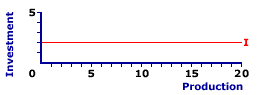
However, investment is realistically induced by the level of income and production in the economy. An induced investment line has a positive slope. And because investment expenditures are only modestly induced by income and production, an induced investment line has a slight slope. A click of the [Induced A Little] button illustrates induced investment (with a comparison to the autonomous investment line). The new red line, labeled I' in the exhibit, is the positively-sloped investment line for the equation: I = 2 + 0.10Y. This line indicates that greater levels of income generate greater investment expenditures by the business sector. The two primary characteristics of this investment line--slope and intercept--indicate the difference between autonomous investment and induced investment.
Other Induced ExpendituresInvestment is one of several induced expenditures. The other three aggregate expenditures--consumption expenditures, government purchases, and net exports--are also induced by income and production.
Check Out These Related Terms... | autonomous investment | investment line | marginal propensity to invest | induced expenditures | induced consumption | induced government purchases | induced imports | slope, investment line | intercept, investment line | injections | leakages | Or For A Little Background... | Keynesian economics | circular flow | aggregate expenditures | investment | investment expenditures | gross private domestic investment | macroeconomics | business sector | national income | gross domestic product | saving | business cycles | And For Further Study... | aggregate expenditures | aggregate expenditures line | investment expenditures determinants | Keynesian model | Keynesian equilibrium | injections-leakages model | aggregate demand | paradox of thrift | fiscal policy | multiplier | Recommended Citation: INDUCED INVESTMENT, AmosWEB Encyclonomic WEB*pedia, http://www.AmosWEB.com, AmosWEB LLC, 2000-2025. [Accessed: December 16, 2025]. |