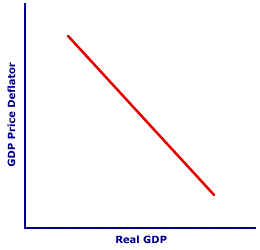
INTEREST RATES, AGGREGATE DEMAND DETERMINANT: One of several specific aggregate demand determinants assumed constant when the aggregate demand curve is constructed, and that shifts the aggregate demand curve when it changes. An increase in interest rates cause a decrease (leftward shift) of the aggregate curve. A decrease in interest rates an increase (rightward shift) of the aggregate curve. Other notable aggregate demand determinants include the federal deficit, inflationary expectations, and the money supply.Interest rates are the annual charge for borrowing funds, usually specified as a percent of the amount borrowed. Changes in interest rates affect the overall expense of borrowing and thus expenditures undertaken with the borrowed funds. Higher interest rates tend to decrease expenditures and lower interest rates lead to an increase in expenditures. Most investment expenditures by the business sector and a fair amount of consumption expenditures by the household sector (especially for durable goods) are made with borrowed funds.
Lower Interest RatesSuppose, for example, that the Federal Reserve System decides to implement expansionary monetary policy. Fearing an impending recession on the business-cycle horizon, they decide to expand the money supply with a corresponding decrease in interest rates.A decline in interest rates can entice the business sector to boost investment expenditures. For example, a 1 percentage point interest rate decline (such as from 10 percent to 9 percent) can reduce the total interest cost on a $10 million construction loan by $300,000 over a five-year repayment period. This saving is bound to convince a few firms to undertake extra investment expenditures. While the numbers might be smaller, a decline in interest rates is also likely to entice the household sector to boost consumption expenditures on durable goods. For example, a 1 percentage point interest rate decline can reduce the total interest cost on a $20,000 car loan by $6,000 over a five-year repayment period. This saving is also bound to convince a few households to make extra consumption expenditures. To see how lower interest rates affect the aggregate demand curve, click the [Lower Rates] button. The lower rates trigger an increase in aggregate demand, which is a rightward shift of the aggregate demand curve. Higher Interest RatesAlternatively, the Federal Reserve System might decide to implement contractionary monetary policy. Fearing the onset of higher inflation, the folks at the Fed might decide to reduce the money supply and subsequently increase interest rates. Higher interest rates have the opposite effect on both business investment and household consumption as lower rates. The interest cost of constructing a new factory is higher. So too is the interest expense of buying a new car.To see how higher interest rates affect the aggregate demand curve, click the [Higher Rates] button. The higher rates trigger a decrease in aggregate demand, which is a leftward shift of the aggregate demand curve. What Does It Mean?The importance of interest rates as an aggregate demand determinant is critical to the study of macroeconomics, and especially business-cycle instability. At the top of the list of reasons for this importance is the frequent use of monetary policy by the Federal Reserve System, as the examples presented here suggest. A key to monetary policy is manipulation of interest rates for the expressed purpose of stimulating or curtailing aggregate demand. However, such monetary-policy manipulation is often implemented to counter interest rate changes that result for other reasons, such as the business cycle. Interest rates tend to rise during expansions and fall during contractions.Ch...Ch...ChangesMake note of the different role that interest rates play in a change in aggregate demand (a shift of the aggregate demand curve) and a change in aggregate expenditures (a movement along the aggregate demand curve). When interest rates change as a result of changes in the price level, the result is a change in aggregate expenditures and a movement along the aggregate demand curve. This is, in fact, the interest-rate effect. If interest rates change for any other reason (and there are many), the result is a change in aggregate demand and a shift of the aggregate demand curve. In this case, interest rates are an aggregate demand determinant.Check Out These Related Terms... | aggregate demand determinants | federal deficit, aggregate demand determinant | inflationary expectations, aggregate demand determinant | money supply, aggregate demand determinant | consumer confidence, aggregate demand determinant | exchange rates, aggregate demand determinant | physical wealth, aggregate demand determinant | financial wealth, aggregate demand determinant | change in aggregate demand | change in aggregate expenditures | aggregate demand shifts | slope, aggregate demand curve | aggregate supply determinants | Or For A Little Background... | aggregate demand | aggregate expenditures | aggregate demand and market demand | determinants | gross domestic product | consumption expenditures | investment expenditures | government purchases | net exports | price level | real production | GDP price deflator | real gross domestic product | paper economy | And For Further Study... | AS-AD analysis | aggregate market | business cycles | circular flow | Keynesian economics | monetary economics | aggregate market shocks | Recommended Citation: INTEREST RATES, AGGREGATE DEMAND DETERMINANT, AmosWEB Encyclonomic WEB*pedia, http://www.AmosWEB.com, AmosWEB LLC, 2000-2025. [Accessed: December 16, 2025]. |