INVESTMENT EXPENDITURES: Expenditures made by the business sector on final goods and services, or gross domestic product, especially the purchase of productive capital goods. Investment expenditures play a central role in macroeconomic activity affecting both short-run business cycles and long-run economic growth. These expenditures reflect the general act of investment involving foregoing current satisfaction to produce capital goods and are officially measured by gross private domestic investment. These are one of four expenditures on gross domestic product. The other three are consumption expenditures, government purchases, and net exports.Investment expenditures average about 10 to 15 percent of annual gross domestic product. These expenditures are used to purchase capital goods that expand the economy's long-run production capabilities and promote economic growth. However, they tend to be unstable and volatile in the short run and are a primary source of business-cycle instability. Investment Times ThreeAlthough the terms investment expenditures and investment are often used interchangeably, they have subtle by distinct meanings. A third related notion is the official government measure of investment--gross private domestic investment.
Business CyclesInvestment expenditures are a key factor in the short run macroeconomic analysis of business cycles. Business cycles are the ups and downs of economic activity. The economy expands for several years, then it contracts for a year or two, then it expands again.The total amount of expenditures undertaken by the business sector on gross domestic product is critical to business-cycle activity. Should the business sector decide to spend more or less on capital goods, then the macroeconomy can experience business-cycle expansions and contractions. Suppose, for example, that profit-seeking firms of the business sector become increasingly optimistic about the state of the economy. They expect the economic future to be bright, rosy, prosperous, and profitable. As such, they increase investment spending on factories, buildings, equipment, and machinery. The result of this additional spending is a short-run business-cycle expansion. However, should the business sector, in mass, become increasingly pessimistic about the future of the economy, then they are inclined to decrease investment expenditures. This reduction will likely trigger a short-run business-cycle contraction. Because investment expenditures tend to be volatile, they are a major source of business-cycle instability. Economic GrowthInvestment expenditures also have a profound impact on the long-run growth of the economy. Devoting a larger (or smaller) share of the economy's gross domestic production to investment expenditures for capital goods means more (or fewer) capital goods are produced.Capital goods are key to the productive capabilities of the economy. An increase in the quantity of capital, expands the ability to produce goods and thus results in economic growth. A decrease in the quantity of capital, diminishes this production capacity. An increase in the production of capital goods inevitably corresponds with a decrease in the production of consumer goods purchased by household sector consumption expenditures. This tradeoff between consumption and investment is fundamental to the process of long-run economic growth. By devoting more resources to investment and less to consumption today, an economy generates greater economic growth in the future. By devoting more resources to consumption and less to investment, economic growth can be less or even negative. A Variety of ExpendituresInvestment expenditures are used to purchase a wide variety of capital goods--literally hundreds of thousands. However, in the macroeconomic analysis of investment, these expenditures are commonly divided into three categories:
The Circular Flow
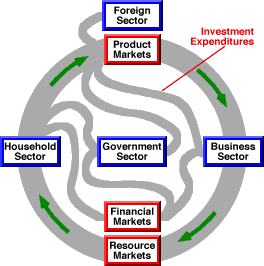
A basic representation of the circular flow is displayed to the right. The components of this model are the four macroeconomic sectors--household, business, government and foreign--and the three macroeconomic markets--product, resource, and financial. The household sector at the far left contains the consuming population of the economy. The business sector at the far right includes all of the producers. The government sector is positioned in the middle of the diagram and the foreign sector is at the very top. The product markets near the top of the flow direct production from the business sector to the household sector in exchange for payment flowing in the opposite direction. The resource markets at the bottom of the flow direct factor services from the household sector to the business sector in exchange for payment flowing in the opposite direction. The financial markets located just above the resource markets divert saving from the household sector to business and government borrowing. The circular flow indicates that the income used by the household sector to purchase goods through the product markets is obtained by selling factor services through the resource markets. It also indicates that the revenue used by the business sector to pay for factor services obtained through the resource markets is generated by selling goods through the product markets. Investment expenditures are the flow between the business sector and the product markets. In particular, the business sector makes investment expenditures to purchase a portion of gross domestic product through the product markets. The business sector pays for these purchases with income received from selling legal claims to the household sector through the financial markets. DeterminantsAt the macroeconomic level, investment expenditures tend to be volatile. The business sector changes investment expenditures from month to month and year to year.The causes of such changes are termed investment determinants. Here are a few of the more important ones:
Three More ExpendituresInvestment expenditures are one of four expenditures on gross domestic product made by the four macroeconomic sectors--household, business, government, and foreign. The other three are consumption expenditures (household sector), government purchases (government sector), and net exports (foreign sector). All together these four are termed aggregate expenditures.
AE = C + I + G + (X-M) Check Out These Related Terms... | investment | investment borrowing | consumption expenditures | consumption | saving | government purchases | net exports | Or For A Little Background... | business sector | production | financial markets | macroeconomics | capital | satisfaction | And For Further Study... | circular flow | business cycles | economic growth | economic goals | macroeconomic sectors | macroeconomic markets | macroeconomic problems | macroeconomic theories | science | investment, production possibilities | economic growth, production possibilities | competitive market | multiplier principle | capital stock, aggregate supply determinant | Recommended Citation: INVESTMENT EXPENDITURES, AmosWEB Encyclonomic WEB*pedia, http://www.AmosWEB.com, AmosWEB LLC, 2000-2025. [Accessed: December 15, 2025]. |