MARGINAL PROPENSITY TO INVEST: The change in business investment expenditures induced by a change in income or production (national income or gross domestic product). The marginal propensity to invest (abbreviated MPI) is another term for the slope of the investment line and is calculated as the change in investment divided by the change in income or production. The MPI plays a role in Keynesian economics. It augments the slope of the aggregate expenditures line and is part to the multiplier process. A related marginal measure is the marginal propensity to consume.The marginal propensity to invest (MPI) indicates the extent to which investment expenditures are induced by changes in income or production. If, for example, the MPI is 01, then each dollar of extra income in the economy induces 10 cents of investment expenditures. The marginal propensity to invest is important to the study of Keynesian economics. First, the MPI reflects induced investment. Second, the MPI is the slope of the investment line, which makes it important to the slope of the aggregate expenditures line, as well. Third, the MPI affects the multiplier process and affects the magnitude of the expenditures and tax multipliers. The MPI FormulaThe standard formula for calculating marginal propensity to invest (MPI) is:This formula has a couple of interpretations.
The Slope Of The Line
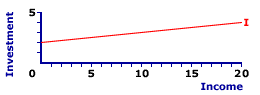
This investment line reflects a plot of the following investment equation: where: I is investment expenditures and Y is income or production (national income or gross domestic product). In particular, as specified in this investment equation, the slope of this investment line is equal to 0.1. This slope value indicates that each $1 change in income induces a $0.1 change in investment. In general, slope is calculated as the "rise" over the "run," that is, the change in the variable on the vertical axis (investment) divided by the change in the variable on the horizontal axis (production or income). The change in investment divided by the change in income or production is the specification of the marginal propensity to invest. That is, the slope of the investment line is the marginal propensity to invest. To highlight this point, click the [Slope] button in this exhibit. Moreover, because the investment line is a straight line, the slope is constant over the entire range of income. This means that the marginal propensity to invest is also constant. MultiplierThe marginal propensity to invest is important to the multiplier process. The multiplier measures the magnified change in aggregate production (gross domestic product) resulting from a change in an autonomous variable (such as investment expenditures). While the marginal propensity to consume is the most important marginal affecting the multiplier process, the marginal propensity to invest also enters the picture.The basic multiplier process results because a change in production (such as what occurs when autonomous government purchases are used for national defense) generates income, which then induces consumption. However, the resulting consumption is also an expenditure on production, which generates more income, which induces more consumption. This next round of consumption also triggers a change in production, which generates even more income, and which induces even more consumption. And on it goes, round after round. The end result is a magnified, multiplied change in aggregate production initially triggered by the change autonomous government purchases, but amplified by the change in induced consumption. The multiplier process with induced consumption is augmented by induced investment. The change in production and income generated by the autonomous change in government purchases induces changes in both consumption AND INVESTMENT. Because both are expenditures on production, both generate more income, which induces more consumption AND INVESTMENT, which generates more income, and which induces even more consumption AND INVESTMENT. The MPI enters into the process along with the marginal propensity to consume (MPC) because it determines how much investment is induced along with the induced change in consumption with each change in production and income. If the MPI is greater, then the multiplier process is also greater as more investment is induced with each round of activity. This connection between the multiplier process, the marginal propensity to consume, and the marginal propensity to invest is illustrated in the standard formula for an expenditures multiplier: An increase in the marginal propensity to invest reduces the value of the denominator on the right-hand side of the equation, which then increases the overall value of the fraction and thus the size of the multiplier. For example, given a marginal propensity to consume of 0.75, a marginal propensity to invest of 0.05 results in a multiplier of 5. In contrast, a larger marginal propensity to invest of 0.15 results in a larger multiplier of 10. Other MarginalsThe marginal propensity to invest is one of several marginals that enters into the study of Keynesian economics. In fact, all induced variables have corresponding marginals that quantify the impact of income changes.Here a few of the more important marginals:
Check Out These Related Terms... | marginal propensity to consume | marginal propensity to import | marginal propensity for government purchases | marginal propensity to save | slope, investment line | induced investment | Or For A Little Background... | investment | investment expenditures | Keynesian economics | business sector | national income | gross domestic product | investment line | And For Further Study... | autonomous investment | derivation, aggregate expenditures line | intercept, investment line | gross private domestic investment | induced expenditures | autonomous expenditures | aggregate expenditures | aggregate expenditures line | investment expenditures determinants | Keynesian model | Keynesian equilibrium | injections-leakages model | aggregate demand | paradox of thrift | fiscal policy | multiplier | Recommended Citation: MARGINAL PROPENSITY TO INVEST, AmosWEB Encyclonomic WEB*pedia, http://www.AmosWEB.com, AmosWEB LLC, 2000-2025. [Accessed: December 15, 2025]. |