PRICE CHANGE, UTILITY ANALYSIS: A disruption of consumer equilibrium identified with utility analysis caused by changes in the price of a good, which likely results in a change in the quantities of the goods consumed. The change in the price alters the marginal utility-price ratio and forces a reevaluation of the rule of consumer equilibrium.Utility analysis can be used to illustrate how a change in the price of a good alters the consumer equilibrium combination of goods consumed. According to the law of demand, a change in the demand price of one good results in an opposite change in the quantity demanded of that good. Moreover, according to the other prices demand determinant, a change in the price of one good is also likely to affect the purchase of another good. As such, this particular utility analysis of consumer equilibrium can provide insight into both the law of demand and the other prices demand determinant. A Review of Consumer Equilibrium
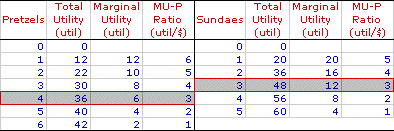
A Sundae Price ChangeThe main point of analysis is to pose the question: What happens if there is a change in the price of one good? In particular, suppose that the price of hot fudge sundaes declines from $4 to $2. How might the consumer equilibrium purchase of pretzels and hot fudge sundaes change?To answer this question, the original consumer equilibrium must be reevaluated. If Duncan continues to consume 3 sundaes and 4 pretzels after the sundae price reduction, his total expenditures are only $14 ($6 spent on 3 sundaes and $8 spent on 4 pretzels). In effect, Duncan has an extra $6 of income to spend. With the lower $2 hot fudge sundae price, Duncan could purchase up to 3 more sundaes. However, in that the pretzel price is also $2, Duncan could purchase up to 3 additional pretzels, too. In fact, because both goods now carry a $2 price, Duncan could purchase any combination of extra pretzels and sundaes that sums up to 3.
This new set of marginal utility-price ratios reveals that the original purchase of 3 sundaes generates 6 utils per dollar, compared to the initial ratio of 3 utils per dollar. Moreover, this new ratio means the rule of consumer equilibrium is now out of balance. The fourth pretzel generates 3 utils per dollar, but the third sundae generates 6 utils per dollar. Because Duncan receives a greater amount of satisfaction per dollar spent on sundaes, it seems reasonable for him to purchase more.
Summing UpWhat can be concluded from this analysis?
Check Out These Related Terms... | income change, utility analysis | preferences change, utility analysis | Or For A Little Background... | Utility analysis | price | consumer equilibrium | law of demand | demand price | quantity demanded | demand determinant | rule of consumer equilibrium | marginal utility-price ratio | satisfaction | And For Further Study... | utility | total utility | consumer demand theory | utility measurement | cardinal utility | ordinal utility | util | utilitarianism | total utility curve | marginal utility curve | diamond-water paradox | elasticity | Recommended Citation: PRICE CHANGE, UTILITY ANALYSIS, AmosWEB Encyclonomic WEB*pedia, http://www.AmosWEB.com, AmosWEB LLC, 2000-2025. [Accessed: December 16, 2025]. |