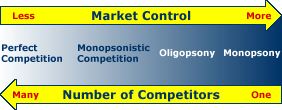
MONOPSONISTIC COMPETITION: A market structure characterized by a large number of small buyers, that purchase similar but not identical inputs, have relative freedom of entry into and exit out of the industry, and possess extensive knowledge of prices and technology. Monopsonistic competition is the buying-side equivalent of a selling-side monopolistic competition. Much as a monopolistic competition is a competitive market containing a number of small sellers, monopsonistic competition is a market containing a number of small buyers. While monopsonistic competition could be analyzed for any type of market it tends to be most relevant for factor markets. Two related buying-side market structures are monopsony and oligopsony.Monopsonistic competition is a market in which a large number of relatively small buyers purchase goods (usually factor inputs) that are similar but not identical. While the market for any type of good, service, resource, or commodity can, in principle, function as monopsonistic competition, this form of market structure tends to be most pronounced for the exchange of factor services. This market structure is the somewhat obscure and less noted buying counterpart of monopolistic competition. However, monopsonistic competition tends to be just as prevalent in the real world. In fact, firms operating as monopolistic competition in an output market often operate as monopsonistic competition in an input market. In much the same way the monopolistic competition is a cross between perfect competition and monopoly, monopsonistic competition is a cross between perfect competition and monopsony. While each monopsonistically competitive buyer has very little market control, it does have some market control, each has its own little monopsony, each faces an input supply curve that is relatively elastic but NOT perfectly elastic. CharacteristicsThe four characteristics of monopsonistic competition are much like those of monopolistic competition: (1) large number of small buyers, (2) similar, but not identical products, (3) relative, but not perfect resource mobility, and (4) extensive, but not perfect knowledge.
Real World (In)EfficiencyA monopsonistically competitive buyer generally purchases less output and pays a lower price than would be the case for perfect competition. In particular, the price paid by a monopsonistically competitive buyer is less than the marginal revenue product.The inequality of price and marginal revenue product violates the key condition for efficiency. Resources are NOT being used to generate the highest possible level of satisfaction. The reason for this inefficiency is found with market control. Because a monopsonistically competitive firm has control over a small slice of the market, it faces a positively-sloped supply curve and price is greater than marginal factor cost, which is set equal to marginal revenue product when maximizing profit. While monopsonistic competition is technically inefficient, it tends to be less inefficient than other market structures on the buying side, especially monopsony. Even though price is less than marginal factor cost (and thus marginal revenue product), because the supply curve is relatively elastic, the difference is often relatively small. For example, a monopsony that pays a $20 price while facing a marginal revenue product of $100 creates a serious inefficiency problem. In contrast, the inefficiency created by a monopsonistically competitive buyer that pays a $49.95 price while generating a marginal revenue product of $50 is substantially less. The closer marginal factor cost is to factor price, the closer a monopsonistically competitive firm comes to allocating resources according to the efficiency benchmark established by perfect competition. In the grand scheme of economic problems, the inefficiency created by monopsonistic competition seldom warrants much attention... and deservedly so. The Other Three Market Structures
Check Out These Related Terms... | oligopsony | monopsony | bilateral monopoly | monopoly | monopsony, efficiency | monopsony, minimum wage | monopsony, factor market analysis | Or For A Little Background... | factor market analysis | factor demand | factor supply | marginal factor cost | marginal factor cost curve, monopsony | profit maximization | efficiency | market control | market structures | monopolistic competition | product differentiation | competition among the many | And For Further Study... | perfect competition, factor market analysis | bilateral monopoly, factor market analysis | factor market, efficiency | compensating wage differentials | monopoly, short-run production analysis | imperfect competition | Recommended Citation: MONOPSONISTIC COMPETITION, AmosWEB Encyclonomic WEB*pedia, http://www.AmosWEB.com, AmosWEB LLC, 2000-2025. [Accessed: December 15, 2025]. |