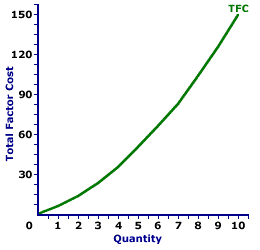
TOTAL FACTOR COST CURVE: A curve that graphically represents the relation between total factor cost incurred by a firm when using a given factor of production to produce a good or service. The total factor cost curve is most important in factor market analysis for the derivation of the marginal factor cost curve. Two related factor cost curves are average factor cost curve and marginal factor cost curve.The total factor cost curve graphically illustrates the relation between total factor cost and the quantity of input used. This curve reflects the degree of market control held by a firm. For a firm with no market control hiring inputs under perfect competition, the total factor cost curve is a straight line that emerges from the origin. For firms with market control, including monopsony, oligopsony, or monopsonistic competition, the total factor cost curve increases at an increasing rate. The shape of the total factor cost curve thus indicates the degree of market control possessed by the factor buyer. Perfect CompetitionPerfect competition is a market structure with a large number of small participants (buyers and sellers). The good exchanged in the market is identical, regardless of who sells or who buys. Participants have perfect knowledge and perfect mobility into and out of the market. These conditions mean perfectly competitive buyers are price takers, they have no market control and must pay the going market price for all inputs bought.
The vertical axis measures total factor cost and the horizontal axis measures the quantity of input (workers). Although quantity on this particular graph stops at 10 workers, the nature of perfect competition indicates it could go higher. This curve indicates that if Maggie hires 1 worker, then she pays $10 of total factor cost. Alternatively, if she hires 10 workers, then she pays $100 of total factor cost. Should she hire 100 workers, then she would move well beyond the graph, with $1000 of total factor cost. The "curve" is actually a "straight line" because Maggie is a price taker in the labor market. She pays $10 for each worker whether she hires 1 worker or 10 workers. The constant price is what makes Maggie's total factor cost curve a straight line, and which indicates that Maggie has no market control. Monopsony, Oligopsony, and Monopsonistic CompetitionFor market structures like monopsony, oligopsony, and monopsonistic competition that have some degree of market control and are price makers rather than price takers, total factor cost is little different. Market control means these market structures face positively-sloped supply curves. As such, the price received is not fixed, but depends on the quantity of the input bought.
The vertical axis measures total factor cost and the horizontal axis measures the quantity of input (workers). Although quantity on this particular graph stops at 10 workers, it could go higher. This curve indicates that if OmniKing hires 1 worker (at $6 per worker), then it pays $6 of total factor cost. Alternatively, if it hires 10 workers (at $15 per worker), then it pays $150 of total factor cost. For OmniKing the total factor cost "curve" really is a "curve." The slope of this curve rises as more labor is hired. The changing slope of this curve is due to the changing price. Although this total factor cost curve is based on the employment activity of OmniKing Island Resort, a well-known monopsony firm, it applies to any buyer with market control. Monopsonistic competition and oligopsony firms that also face positively-sloped supply curves generate comparable total factor cost curves. Check Out These Related Terms... | total factor cost | total factor cost curve, perfect competition | total factor cost curve, monopsony | total factor cost, perfect competition | total factor cost, monopsony | average factor cost | marginal factor cost | average factor cost curve | marginal factor cost curve | total cost | total product | Or For A Little Background... | market structures | perfect competition | perfect competition characteristics | perfect competition and demand | monopsony | oligopsony | monopsonistic competition | supply | supply price | law of supply | efficiency | And For Further Study... | factor market analysis | short-run production analysis | marginal factor cost and average factor cost | factor supply | factor supply curve | supply by a firm | supply to a firm | mobility | Recommended Citation: TOTAL FACTOR COST CURVE, AmosWEB Encyclonomic WEB*pedia, http://www.AmosWEB.com, AmosWEB LLC, 2000-2025. [Accessed: December 16, 2025]. |