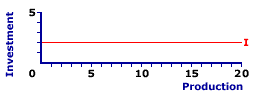
AUTONOMOUS INVESTMENT: Business investment expenditures that do not depend on income or production (especially national income or even gross domestic product). That is, changes in income do not generate changes in investment. Autonomous investment is best thought of as investment that the business sector undertakes regardless of the state of the economy. It is measured by the intercept term of the investment line. The alternative to autonomous investment is induced investment, which does depend on income.Autonomous investment is investment expenditures by the business sector that are unrelated to and unaffected by the level of income or production. This is one of two basic classifications of investment. The other is induced investment, investment expenditures that are based on the level income or production. In other words, business investment can be divided into: (1) expenditures which are undertaken by the business sector regardless of the level of aggregate production and (2) an adjustment of expenditures (more or less) that results because aggregate production and income changes. While autonomous investment expenditures are unaffected by income and are held constant for the construction of the investment line, they are not absolutely constant, they do change. Autonomous investment is affected by investment expenditures determinants, such as interest rates, expectations, technology, and capital prices. Changes in these and other determinants cause changes in autonomous investment, which shift the investment line as well as the aggregate expenditures line and disrupt whatever equilibrium might exist. Investment expenditures are commonly assumed to be totally autonomous in the introductory analysis of Keynesian economics. That is, any induced investment that might realistically exist is ignored. Doing so not only simplifies the analysis, but also places the focus on how and why autonomous investment changes, and how such changes affect the macroeconomy. More sophisticated, and realistic, analysis then includes induced investment. Autonomous: An EquationOne way to provide an illustration of autonomous investment (and the relation to induced investment) is with a general linear investment equation, such as the one presented here:where: I is investment expenditures, Y is income (or aggregate production), e is the intercept, and f is the slope. The two key parameters that characterize this investment equation are slope and intercept. Autonomous investment is indicated by the intercept of the investment equation. Induced investment is then indicated by the slope.
Autonomous: A Line
For sake of comparison, an induced investment line would have a positive slope. And because investment expenditures are only modestly induced by income and production, an induced investment line has a slight slope. A click of the [Induced A Little] button illustrates induced investment (with a comparison to the autonomous investment line). Investment Expenditures DeterminantsAutonomous investment is most important to Keynesian economics not because it is unaffected by income, but because it IS affected by a host of nonincome factors. These nonincome influences on investment expenditures are termed investment expenditures determinants.These determinants, similar to those for other relations in the study of economics, cause a change in the underlying investment-income relation. From a graphical perspective, these determinants cause the investment line to shift, which effectively means that the intercept of this line changes. More generally, these determinants cause a change in autonomous investment. A few of the more important investment expenditures determinants are:
Other Autonomous ExpendituresInvestment is one of four expenditures on aggregate production in the macroeconomy. The other three--consumption expenditures, government purchases, and net exports--also have important autonomous components. While autonomous investment tends to be extremely important as a source of business-cycle instability, the autonomous components of these other expenditures are also important in Keynesian economics.
Check Out These Related Terms... | induced investment | investment line | marginal propensity to invest | autonomous expenditures | autonomous consumption | autonomous government purchases | autonomous net exports | intercept, investment line | slope, investment line | injections | leakages | induced expenditures | Or For A Little Background... | Keynesian economics | circular flow | aggregate expenditures | investment | investment expenditures | gross private domestic investment | macroeconomics | business sector | national income | gross domestic product | saving | business cycles | determinants | And For Further Study... | aggregate expenditures | aggregate expenditures line | investment expenditures determinants | Keynesian model | Keynesian equilibrium | injections-leakages model | aggregate demand | paradox of thrift | fiscal policy | multiplier | Recommended Citation: AUTONOMOUS INVESTMENT, AmosWEB Encyclonomic WEB*pedia, http://www.AmosWEB.com, AmosWEB LLC, 2000-2025. [Accessed: December 16, 2025]. |