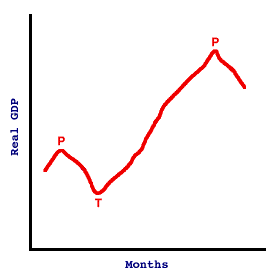
COINCIDENT ECONOMIC INDICATORS: Four economic statistics that tend to move up or down along WITH business-cycle expansions and contractions. Most importantly, these measures indicate peak and trough turning points when they actually occur. Coincident economic indicators are one of three groups of economic measures used to track business-cycle activity. The other two are leading economic indicators and lagging economic indicators.Coincident economic indicators provide monthly tracking of business-cycle activity. They give consumers, business leaders, and policy makers an idea about where the economy is currently, right now. When the economy rises today, then coincident indicators are also rising right now. And when the economy declines today, then coincident indicators are also declining right now. The actual measures used as coincident economic indicators are collected by different government agencies and private groups, including the Bureau of Labor Statistics and Bureau of Economic Analysis. These measures are then compiled by economists and number crunchers at the Conference Board. Four MeasuresThe four coincident economic indicators that indicate the actual incidence of business-cycle peaks and troughs are: (1) the number of employees on nonagricultural payrolls, (2) industrial production, (3) real personal income (after subtracting transfer payments), and (4) real manufacturing and trade sales.Each of these four individual indicators is useful in its own right, but when combined as a composite measure, even greater insight into the business-cycle activity is achieved. How They TrackThis exhibit can be used to illustrate how coincident economic indicators relate to the official tracking of business-cycle peaks and troughs.First, take note of the somewhat jagged red line displayed in the exhibit. It provides a hypothetical tracking of real gross domestic product over several months. Two peaks are evident, labeled with P. One trough is displayed as well, marked by T.
Here and NowCoincident economic indicators "coincide" with aggregate business-cycle activity. They rise and fall as overall economic activity rises and falls. These indicators, in effect, document actual business-cycle events. Coincident economic indicators are a primary source of information used to document "official" business-cycle turning points.Having accurate information about CURRENT economic conditions is not as easy as it might seem. Collecting, processing, and analyzing data takes time. While financial data (stock market prices, interest rates, etc.) are available almost instantaneously, most information about the economy is available only weeks, if not months, after the fact. Coincident indicators are some of the most timely economic measures available. Practical and TheoreticalCoincident indicators are chosen primarily because they have been shown to work, to mark the incidence of business cycle peaks and troughs. However, they also draw on theoretical cause-and-effect relations that make up the complex cause-and-effect process that underlies business cycles. These are the key dimensions of the economy that are caused by variables that make up the leading indicators and they subsequently cause changes in the variables that make up the lagging indicators.In particular, coincident economic indicators measure four key aspects that is the aggregate economy--employment, production, income, and sales. When concerns are directed toward the current state of the macroeconomy, these are the four most important areas of interest. When the aggregate economy is expanding or contracting, these are the four areas that are expanding and contracting. The Other TwoWhile coincident economic indicators document the current state of business cycles, the other two--leading and lagging--also have important roles to play in tracking business cycles.
Check Out These Related Terms... | business cycle indicators | leading economic indicators | lagging economic indicators | Or For A Little Background... | business cycles | business cycle phases | potential real gross domestic product | full employment | expansion | contraction | peak | trough | And For Further Study... | investment business cycles | political business cycles | demand-driven business cycles | supply-driven business cycles | unemployment | inflation | Recommended Citation: COINCIDENT ECONOMIC INDICATORS, AmosWEB Encyclonomic WEB*pedia, http://www.AmosWEB.com, AmosWEB LLC, 2000-2025. [Accessed: December 16, 2025]. |