SELF CORRECTION, RECESSIONARY GAP: The automatic process in which the aggregate market eliminates a recessionary gap created by a short-run equilibrium that is less than full employment through decreases in wages (and other resource prices). The self-correction mechanism is triggered by short-run resource market imbalances that are closed by long-run price flexibility. The self-correction process of the aggregate market also acts to close an inflationary gap with higher wages (and other resource prices).Self correction is seen as shifts of the short-run aggregate supply curve caused by changes in wages and other resource prices. The self-correction mechanism acts to close a recessionary gap with lower wages and an increase in the short-run aggregate supply curve. With a recessionary gap, short-run equilibrium real production is less than full-employment real production, meaning resource markets have surpluses. In particular, labor unemployment exceeds the natural rate. Self correction is the process in which these temporary imbalances are eliminated through flexible prices as the aggregate market achieves long-run equilibrium. The key to this process is that changes in wages and other resource prices cause the short-run aggregate supply curve to shift.
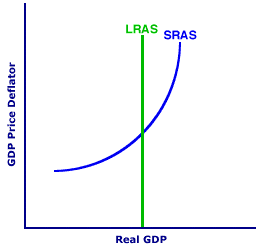
This graph presents the two aggregate supply curves--long run and short run--but no aggregate demand curve. The vertical curve labeled LRAS is the long-run aggregate supply curve which marks full-employment real production. The positively-sloped curve labeled SRAS is then the short-run aggregate supply curve. The positioning of the aggregate demand curve and the point of intersection with the short-run aggregate supply curve indicates the recessionary gap.
Note that the SRAS curve shifts rightward until it intersects BOTH the LRAS and AD curves at full-employment real production, which is long-run equilibrium. In particular, the new long-run equilibrium is at the full-employment level of real production. The SRAS curve absolutely MUST shift until this long-run equilibrium is reached. If the aggregate market does NOT reach long-run equilibrium, resource market imbalances persist, resource prices and production cost decline further, and the SRAS curve shifts more. However, once long-run equilibrium is reached, resource market imbalances are eliminated, resource prices and production cost do not change, and the SRAS curve does not shift any further. Check Out These Related Terms... | self correction, aggregate market | self correction, inflationary gap | aggregate market shocks | equilibrium, short-run aggregate market | equilibrium, long-run aggregate market | disequilibrium, short-run aggregate market | equilibrium, aggregate market | Or For A Little Background... | output gaps | recessionary gap | inflationary gap | aggregate market analysis | short-run aggregate market | long-run aggregate market | aggregate demand | aggregate supply | aggregate demand curve | long-run aggregate supply curve | short-run aggregate curve | full employment | business cycles | contraction | expansion | inflation | unemployment | And For Further Study... | Keynesian economics | monetary economics | classical economics | aggregate supply increase, short-run aggregate market | aggregate supply decrease, short-run aggregate market | Recommended Citation: SELF CORRECTION, RECESSIONARY GAP, AmosWEB Encyclonomic WEB*pedia, http://www.AmosWEB.com, AmosWEB LLC, 2000-2025. [Accessed: December 16, 2025]. |